
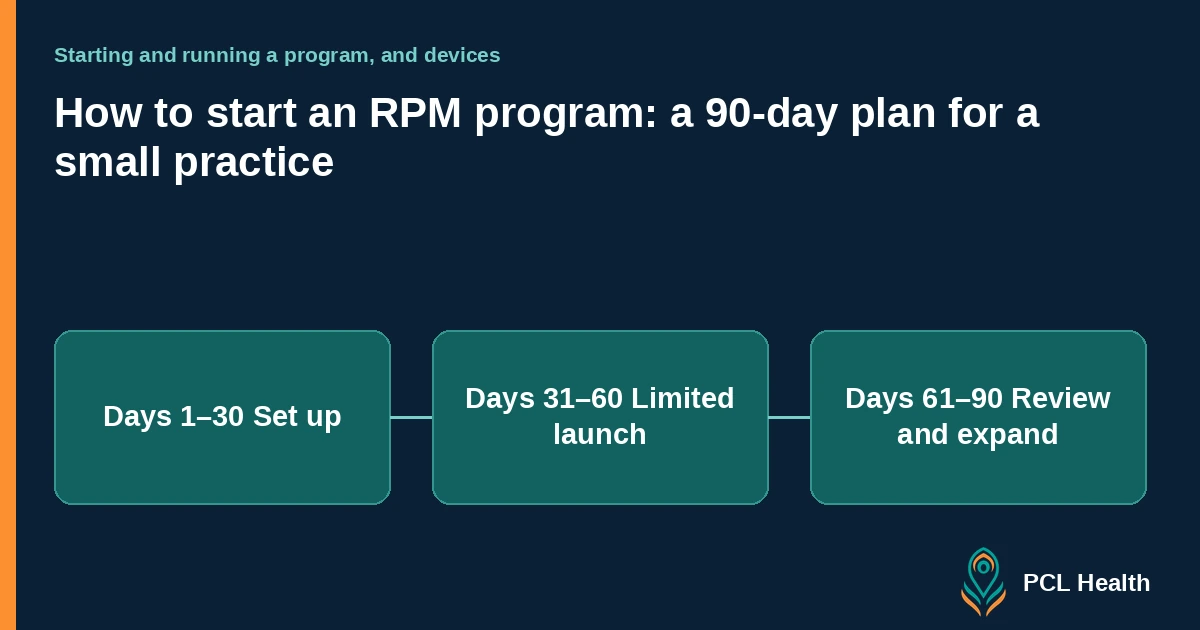
A small practice can start an RPM program by using the first 90 days to define responsibilities, test onboarding and review its records before expanding. Set a decision gate at the end of each stage, with an owner for every unfinished task. Your clinical lead should approve patient-selection criteria and clinical procedures before enrollment starts.
What should the practice decide in the first two weeks?
Choose an accountable clinical lead, an operations owner and a billing reviewer, then agree what the initial program will do. Write the patient-selection process, monitoring responsibilities and escalation pathway before choosing a launch date. Give each owner a written task list and agree how they will handle unfinished work and staff absences.
Begin with one clearly described workflow rather than a broad list of conditions. The clinical lead decides what information is useful and how the practice responds. The operations owner describes the tasks required to collect that information. The billing reviewer identifies the evidence the practice needs to assess services later.
CMS's current guidance describes RPM for acute or chronic conditions and requires medical necessity, an established patient relationship and consent. CMS MLN, December 2025 (2026 guidance) Use those requirements to review your enrollment checklist with the clinical lead.
In your first planning meeting, settle three questions. Who can say that a patient is suitable? Who can explain the program to the patient? Who can stop an enrollment when a required step is missing? Record the answers and the backup role for each decision. The result should be a short operating document that staff can use during a busy clinic session.
How should the 90 days be divided?
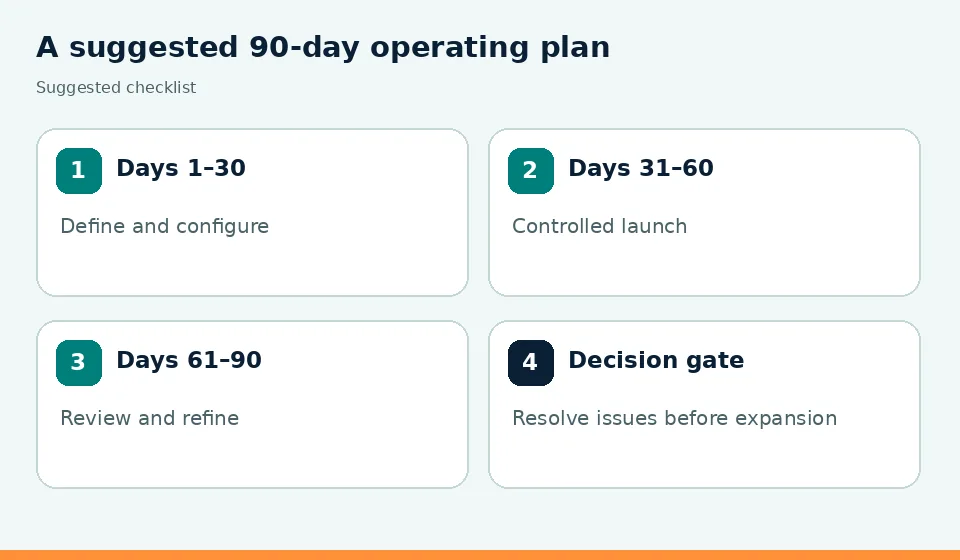
Use three stages: define and configure, run a controlled launch, then review and refine. Give each stage a deliverable and a decision gate. At each gate, review what your team can complete reliably and assign corrections before adding more work to the queue.
The first stage is for responsibilities, device workflow and record requirements. During the second stage, use a limited launch that the team can supervise closely. During the third, examine what happened and decide whether the operating process is ready for a larger workload.
Avoid defining success only as the number of patients enrolled. A patient can be enrolled without knowing how to send a reading, and a functioning device can still feed a queue nobody owns. Review the service from the patient's instruction to the practice's documented response.
Keep a decision log. If the team changes a reminder schedule or a handoff procedure, record why and when. That history will help staff understand which version applies when they look back at an early record.
For a kidney practice starting with an RPM vendor’s nurses doing the daily monitoring, make the staffing review part of days 1–30. If the proposed employment restriction is finalized as drafted, practice-employed clinical staff would need to perform the monitoring services for Medicare payment. CMS CY 2027 proposed rule, 2026 Use days 31–60 to test a handoff to your own nurse: incoming readings, patient contacts, unresolved issues and documentation. During days 61–90, check backup coverage and whether your nurse can run the queue alongside existing responsibilities.
| Stage | Suggested timing | Deliverable before moving on |
|---|---|---|
| Define and configure | Days 1–30 | Roles, procedures and a tested sample workflow |
| Controlled launch | Days 31–60 | Documented onboarding and reviewed exception handling |
| Review and refine | Days 61–90 | Record review, coverage check and expansion decision |
What should staff test before the first enrollment?
Test the complete data path and the human handoffs using a sample record. Check device registration, pairing, transmission, visibility to staff and the response to a missing reading. Include a failed step, not just a successful demonstration. Staff should be able to say who owns the issue and where its resolution is recorded.
After the demonstration, ask your coordinator to run the workflow independently. Ask the coordinator to repeat the process without the vendor talking through every click. If the coordinator cannot find the reading or the unresolved issue, revise the instruction before using the process with patients.
PCL Health uses Bluetooth blood pressure cuffs, glucometers, scales and a watch that pair with the patient app. The clinics page describes enrollment, monitoring, follow-up and billing documentation. Ask for a demonstration of the device-to-workspace sequence and the records visible to the team. Explore the For clinics page.
Build an equipment checklist for the actual devices selected. Assign someone to manage registration, replacement questions and unresolved connection issues. Have the clinical lead approve measurement instructions using the selected device’s instructions and your practice procedure.
How should the patient onboarding session work?
Explain the purpose of the program, show the patient how the selected device and application work, and ask the patient to demonstrate the process back. Identify how the patient obtains help and how the practice communicates. Document the onboarding session and any unresolved issue instead of assuming that a device handover completes training.
CMS describes patient education and setup as a component of RPM. CMS RPM guidance, reviewed 2026 For the operating plan, make that component observable: the record should explain what instruction occurred and whether the transmission path worked. Do not write 'trained' when the patient only received a box or a link.
Use a hypothetical session to train staff. The patient can open the app but cannot see a reading. The coordinator should work through the agreed troubleshooting process and record what remains unresolved. Record whether the coordinator finds the problem, resolves it or sends it to the right owner.
Discuss caregiver involvement separately where appropriate. Confirm what the patient wants and what your procedure allows. A family member helping with setup should not be assumed to have unrestricted access to all records. Keep patient instruction, access decisions and communication preferences distinguishable.
Who should own the daily monitoring queue?
Assign a primary queue owner, a clinical escalation owner and backup coverage for each working day. Define when the queue is reviewed and how unresolved tasks are carried forward. A written handoff should show the problem, the next action and the responsible person, so unfinished work does not disappear when a staff member is absent.
Test the coverage plan with a coordinator on leave. Ask who can see the open issues, how that person recognizes an urgent clinical handoff under the practice's procedure, and where the action is recorded. Do not rely on a private inbox or one employee's memory as the only handoff mechanism.
Use task categories the team can understand: no reading received, connection problem, patient question and clinician review requested. The clinical lead should approve the actual response and escalation instructions used by staff.
Review the queue during the controlled launch. Look for tasks that repeatedly return without a resolution. An issue may need better patient instruction, a clearer owner or a more useful record. Correct the cause before increasing the volume of work the team must manage.
Where can AI follow-up help without replacing clinical work?
Use AI follow-up for a defined supporting task, such as a missed-reading reminder, while retaining the practice's clinical review and communication responsibilities. Do not present an automated AI call as meeting qualifying interactive communication. CMS describes a real-time, two-way conversation for the familiar treatment-management codes. CMS CY 2021 final-rule fact sheet, 2020 Staff need to understand that distinction before launch.
Write the boundary into the procedure. Describe what starts a reminder, what the patient is being asked to do and how the team sees the summary. Then describe which questions or unresolved issues need staff attention. Do not make the automated event the default evidence of a completed clinical interaction.
Try a sample case in which the patient does not provide a reading after the reminder. The procedure should say who sees the unresolved task and what happens next. Another sample case can show an automated reminder followed by a staff conversation. The records should distinguish those events without relying on someone to remember the sequence.
A launch meeting should include the people who review billing documentation as well as the people using the daily queue. The two groups need the same understanding of what the software event means and what it does not establish.
What should the practice review before expanding?
Review onboarding records, transmission issues, unresolved tasks, staff coverage and the evidence used for billing review. Expansion should follow a documented decision that the team can deliver the operating procedure consistently. Use the early records to improve the workflow rather than treating enrollment volume alone as proof that the program is ready.
Take a small sample of records and reconstruct each patient's workflow. Can another team member find the setup information, incoming data, follow-up action and responsible person? If not, fix the structure or staff instruction before adding more work.
Keep the review factual. Record missing evidence, repeated connection questions and unclear handoffs. Compare the recorded action with your agreed procedure and investigate any missing handoff. Have your billing reviewer check the underlying work before approving a submission.
Finish with a clear decision: continue the controlled launch, revise a process or expand within agreed capacity. Give each correction an owner and a review date. Keep a short decision log showing what you changed after the initial launch and why.
- Review sample records from onboarding through follow-up.
- Check coverage during absences and unresolved-task handoffs.
- Review the billing evidence with the responsible staff.
- Assign corrections with owners and review dates.
- Record the clinical and operational expansion decision.
How should the launch plan handle the proposed 2027 changes?
Keep a separate contingency for CMS's proposed employment and initiating-visit requirements, alongside the code-consolidation comment solicitation. CMS proposed-rule fact sheet, July 14, 2026 CMS CY 2027 proposed rule, 2026 Do not redesign current billing solely around a proposal. Assign a policy-review owner and make the final-rule review a formal decision gate for any affected staffing, onboarding or reporting changes.
Prepare the information the review will need: the staffing map, current onboarding pathway, contract scope and report examples. These are useful management documents regardless of whether every proposed provision is adopted. They also make a later change easier to explain to staff.
For a broader launch discussion, the related billing and platform-licensing guides provide complementary questions. Use them to check the evidence and supplier scope, while keeping your clinical procedures and patient-specific decisions under the practice's own review. A workable program starts with named responsibilities and continues with records the team can retrieve and understand.
Frequently asked questions
How should you adapt the 90-day plan?
Adjust each stage to your staffing, device readiness and procedure approvals. Keep the review gates so unresolved problems have an owner before you expand.
What should be ready before enrolling the first patient?
The team should have agreed roles, a tested sample workflow and a documented onboarding procedure. Staff should also know how to handle a failed transmission and an unresolved patient question.
Can AI calls replace the clinical team?
Keep clinical decisions and escalation with your clinical team. Automated reminders support follow-up while the practice retains clinical decisions, escalation and the required human communication workflow.
When should a practice expand its initial launch?
Expand after reviewing early records, unresolved issues and backup coverage. Document the decision and assign corrections before increasing the work the team must manage.
Sources
- CY 2021 PFS final-rule fact sheet; Remote Physiologic Monitoring Services — CMS CY 2021 final-rule fact sheet, 2020.
- Telehealth & Remote Monitoring, MLN901705; page 13 — CMS MLN, December 2025 (2026 guidance).
- CY 2027 PFS proposed-rule fact sheet; Remote Monitoring — CMS proposed-rule fact sheet, July 14, 2026.
- Remote Patient Monitoring — CMS RPM guidance, reviewed 2026.
- CY 2027 PFS proposed rule, CMS-1848-P; section II.E.48, pages 148–158 of display PDF — CMS CY 2027 proposed rule, 2026.
- PFS Federal Regulation Notices — CMS rule notices.