
White-label RPM buyers should compare building, licensing and acquisition by the rights, responsibilities and operating work each option creates. Choose a model after testing the patient-to-clinician workflow and reviewing the contract scope. A branded interface alone does not answer questions about clinical staffing, data access or ongoing platform maintenance.
How do build, license and acquisition differ?
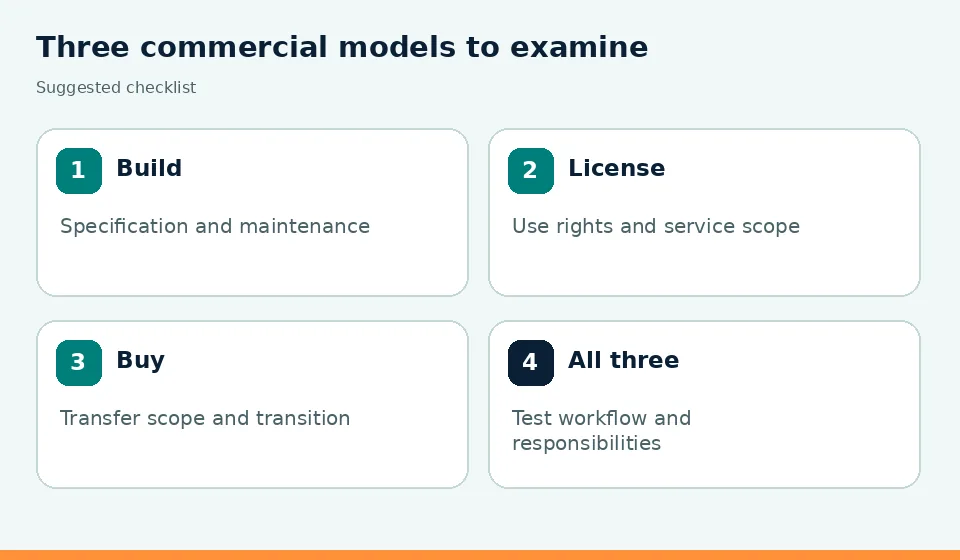
Building means commissioning and maintaining a platform; licensing means obtaining defined rights to use an existing platform; acquisition means negotiating ownership of specified assets or a business. For each option, write down the rights you receive and the work your team will own. Compare the actual scope, obligations and exclusions before deciding which arrangement fits your operating plan.
A build project needs a specification, a delivery team and a maintenance owner. A license needs clear use rights and a service scope. An acquisition needs a carefully defined transaction and appropriate specialist review. None of those labels by itself identifies who supports patients or performs clinical services.
Start with the service you intend to run. A device company serving clinics may need a different platform scope from a practice running its own program. A buyer looking for ownership has different questions from a buyer needing a branded launch. Put that operating brief in front of every vendor so you compare the same scope.
Use the table to organize the conversation rather than to rank the models universally. Ask for evidence against each question, and keep unanswered items visible in the procurement record.
| Option | Core question | Responsibility to define |
|---|---|---|
| Build | What must be designed and delivered? | Specification, testing, maintenance and change ownership |
| License | What rights and services are included? | Permitted use, branding, support scope and exit |
| Acquire | What exactly transfers? | Assets or business scope, transition and continuing obligations |
What should a buyer define before requesting a demonstration?
Define the target users, operating workflow, staffing model and required platform scope. Identify the records each role needs to create or review. Then ask for a demonstration against that scenario, rather than a general product tour. A clear brief makes it easier to distinguish an existing capability from a proposed customization or future commitment.
Specify who the buyer expects to serve: clinics, practice staff, patients and family caregivers may have different access needs. Describe the task for each group. For example, the coordinator needs to find a missing reading; the clinician needs the related record; the patient needs to understand what to do next.
Also define how facilities or organizations would be managed. Ask which permissions are currently available and how the vendor demonstrates role differences. Do not assume that a sales description of 'enterprise' includes the exact administrative structure your operating model needs.
Use a scope table with three columns: available now, requires configuration and requires a separate commitment. Ask your vendor to complete it during the demonstration and carry it into the contract discussion. That simple distinction prevents a proposed capability from being treated as something already supplied.
How should the buyer test the connected RPM workflow?
Follow one hypothetical patient from enrollment and device setup through a reading, a missing-reading event, follow-up and record review. Ask the vendor to demonstrate the handoffs between users. Include a correction and an unresolved issue. Follow the work across the screens and check whether your staff can retrieve the supporting records later.
Ask to see the same event from the coordinator and clinician perspectives. Can the team identify the patient, period, action and responsible role? Can a reviewer retrieve the relevant record later? A task that appears complete on one screen may still need a clinical or operational handoff.
PCL Health's partnership offering includes the platform, patient app, Care Circle app, AI calls and billing module. The platform currently maps four RPM codes: 99453, 99454, 99457 and 99458. Use the partners page to prepare your scope questions before the demonstration. Explore the Partners page.
Finish the demonstration by asking for an exception report or a walkthrough of unresolved tasks. You need to know what happens when a reading is missing or a user cannot complete a step. Those situations are part of the operating model the buyer will launch.
What should be agreed about branding and configuration?
Document the brand assets, application names, user-facing text, configuration responsibilities and approval process. Specify what the buyer can change and what remains controlled by the supplier. Use an acceptance checklist with named owners. Do not assume that permission to use a brand includes unrestricted rights to modify software or distribute applications.
A white-label launch can involve more than a logo. Discuss how organization names appear, which patient instructions need review and who approves any change to the workflow. Keep the design decision separate from the clinical and operational decision behind the instruction.
Ask for an example of the configuration process. Which changes can an administrator make? Which require a supplier request? How does the buyer test the result before it reaches users? Ask your vendor to show the current configuration process and identify any development work separately.
Put the acceptance process in writing. A named buyer owner should review brand presentation, a clinical owner should review patient-facing instructions and an operations owner should test the workflow. Retain the accepted version so later changes have a clear starting point.
What security and data questions belong in the scope?
Review the data flow, access roles, hosting description, business associate arrangements and process for retrieving records. Ask for evidence and contract language rather than treating a badge as the entire security review. Separate the supplier's documented responsibilities from the buyer's own responsibilities, and assign unresolved questions to the appropriate privacy or legal adviser.
HHS guidance explains that a cloud provider maintaining electronic protected health information on behalf of a covered entity or business associate can itself be a business associate, including when it cannot view encrypted data. HHS also describes the need for the appropriate business associate agreement. HHS cloud guidance, reviewed 2022 HHS business-associate guidance, reviewed 2026 Do not infer the full relationship solely from the hosting brand.
PCL Health states that the platform is HIPAA-compliant, US patient data is hosted on AWS in the United States and encrypted in transit and at rest, and a BAA is available. Review the actual agreement and operating scope before you sign.
For procurement, ask who can grant and remove access, how role differences are tested and how the buyer retrieves audit records. Also ask what happens at termination. Give your privacy lead the data-flow description, access model and proposed agreement to review.
Who will maintain the platform and handle change requests?
Name the maintenance owner and define the process for defects, updates, configuration changes and policy-related reporting changes. Separate the current service scope from any proposed development work. A buyer should understand how requests are assessed, approved, tested and delivered, and who owns the operational communication when users need to follow a revised procedure.
In a build model, the buyer needs an explicit plan for ongoing maintenance after initial delivery. In a license model, the agreement should describe which services the supplier provides. In an acquisition, transition arrangements need careful review. Put the agreed maintenance and transition responsibilities into the scope document.
Use a hypothetical incident to test the process. A staff user cannot retrieve a record needed for review. Who receives the issue, who assesses it and how does the buyer track the outcome? Ask for the process without assuming a response time or support availability that has not been agreed.
Do the same with a policy change. The buyer may need a revised report, staff instruction and a change to review procedures. Determine which parts belong to the supplier and which remain with the buyer. A software update alone does not rewrite the clinical service or the payer review process.
How do staffing proposals affect a platform decision?
Keep the software transaction separate from the clinical staffing assessment. CMS proposes practice-employed staff and an initiating visit, and seeks comment on code consolidation for RPM and RTM. CMS proposed-rule fact sheet, July 14, 2026 CMS CY 2027 proposed rule, 2026 These are proposed policies or a comment solicitation. Include them in a contingency review without claiming a particular platform model resolves future payment requirements.
Map the people who would perform services under the buyer's operating model. Record the employer, supervisor and backup coverage alongside the software roles. Obtain appropriate advice on uncertain arrangements rather than trying to settle them through a branding or licensing clause.
Keep the AI boundary clear in the demonstration and staff training. An automated AI call supports follow-up, but must not be presented as meeting qualifying interactive communication. CMS describes a real-time, two-way conversation for 99457 and 99458. CMS CY 2021 final-rule fact sheet, 2020 The procurement test should show how reminder events and staff conversations remain distinguishable.
Buyers should assess their own proposed model and the relevant contracts. Match each service to a responsible person, employer and contract obligation.
What should be completed before signing and launching?
Complete the workflow demonstration, scope review, responsibility map and acceptance checklist before approving launch. Resolve material questions about rights, data access, maintenance and exit with appropriate advisers. Record which assumptions remain open and who owns them. Launch planning should follow a defined agreement and tested procedure, not fill gaps left by a sales discussion.
Use one final meeting to reconcile the demonstration with the written scope. If a capability was described as configuration-dependent, identify the configuration and acceptance task. If it required development, identify the separate commitment. If it was outside scope, remove it from the launch assumption.
For the operating plan, the related practice-launch guide and delivery-model comparison provide complementary checklists. They help connect the platform decision to the staff who will use it. Your final scope should explain why you chose the model and which responsibilities stay with your team.
- Agree the target users and operating model.
- Demonstrate the workflow and its exceptions.
- Review rights, responsibilities and data arrangements.
- Confirm configuration and acceptance owners.
- Approve the launch procedure and contingency review.
Frequently asked questions
Is white-label RPM a complete clinical service?
A white-label agreement describes the platform and branding scope agreed by the parties. Review clinical staffing and service delivery separately rather than assuming they are included.
Does licensing give the buyer ownership of the software?
Do not assume ownership from a license label. Review the rights granted, restrictions and termination provisions in the actual agreement with appropriate advice.
What should an acquisition discussion specify?
Specify exactly which assets or business interests are proposed to transfer and what the transition includes. Ownership, continuing obligations and maintenance arrangements need specialist review before commitment.
What is the most useful first demonstration?
Ask for a complete hypothetical patient workflow, including a missed reading and an unresolved issue. That test shows the handoffs and records more clearly than a sequence of attractive screens.
Sources
- Business Associates — HHS business-associate guidance, reviewed 2026.
- Guidance on HIPAA & Cloud Computing; questions 1 and 2 — HHS cloud guidance, reviewed 2022.
- CY 2021 PFS final-rule fact sheet; Remote Physiologic Monitoring Services — CMS CY 2021 final-rule fact sheet, 2020.
- CY 2027 PFS proposed-rule fact sheet; Remote Monitoring — CMS proposed-rule fact sheet, July 14, 2026.
- CY 2027 PFS proposed rule, CMS-1848-P; section II.E.48, pages 148–158 of display PDF — CMS CY 2027 proposed rule, 2026.
- PFS Federal Regulation Notices — CMS rule notices.