
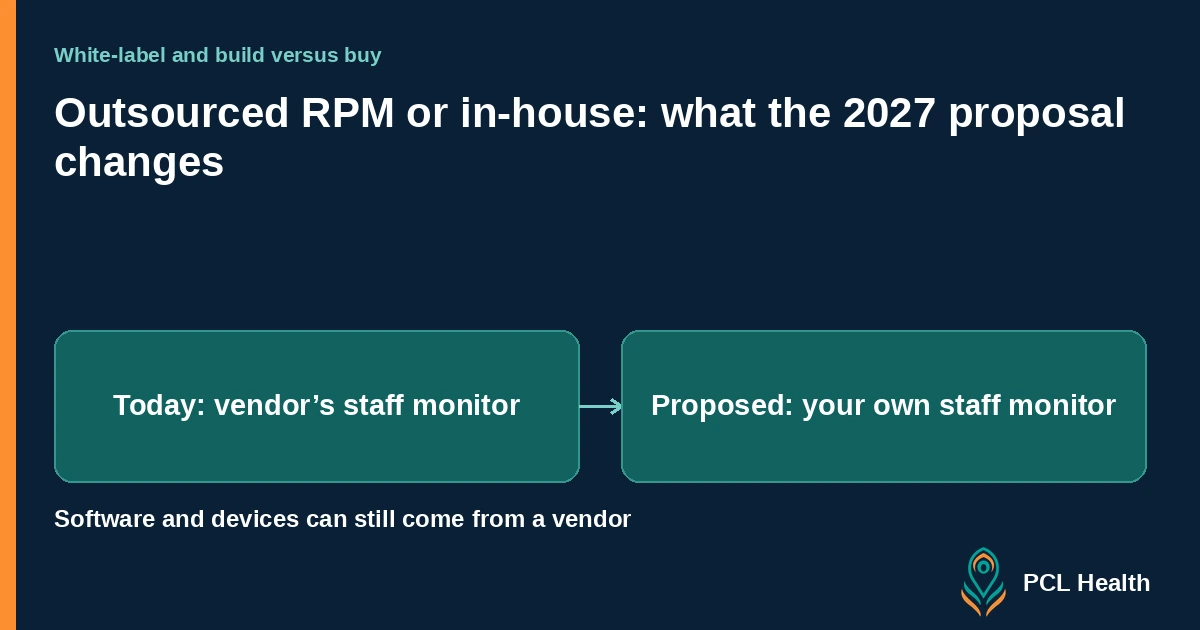
The proposed 2027 RPM policy makes employment arrangements a planning question when comparing outsourced and in-house programs. It does not make a delivery model compliant simply because it is called in-house, or make software licensing the same thing as outsourced clinical services. CMS proposed-rule fact sheet, July 14, 2026
What does the proposal change in the outsourcing comparison?
CMS proposes restricting payment to services performed by practice-employed clinical staff; the detailed rule discusses direct employment. CMS CY 2027 proposed rule, 2026 For procurement, review the actual staffing arrangement separately from the software contract. Your comparison should show who does each task, how you supervise the work and where you retrieve the evidence.
For vendor-supported programs, January 1, 2027 is the proposed effective date of the staffing change, if CMS finalizes it. CMS CY 2027 proposed rule, 2026 The comment period ended on September 14, 2026. CMS regulation notice, 2026 CMS also proposes lower valuations for some remote monitoring codes, with changes to device-supply inputs and removal of practice-expense inputs for treatment-management codes. CMS CY 2027 proposed rule, 2026 CMS proposed-rule fact sheet, July 14, 2026 Buying software, devices and platforms from vendors could continue while your directly employed clinical staff provide the services; this distinction follows from the proposed staffing clause’s focus on clinical-service delivery. CMS CY 2027 proposed rule, 2026
Review two budgets before you commit to a staffing change: one using current payment assumptions and one allowing for the proposed valuation changes. Include nurse coverage, onboarding time, device costs and the software contract. Keep the final-rule review as the approval point for your revised operating plan.
Start with the task list. A clinic with internal staff can still have unclear handoffs or weak documentation. An outside supplier can provide useful technology without supplying the clinical staff. Ask for the actual task allocation and staffing arrangement.
Ask each bidder to separate the scope into software, device logistics, onboarding support, clinical services and billing support. Then identify which parts the practice proposes to retain. This makes it easier to compare offers without suggesting that a particular label settles future payment questions.
How should practices compare the daily operating models?
Compare models using the same ordinary working-day scenario. Follow a missing reading from detection through patient contact, clinician review and documentation. Ask who owns each step and what happens during an absence. A fair comparison describes responsibilities and tradeoffs before discussing the commercial package or preferred organizational structure.
Consider a cardiology practice where the RPM vendor’s nurses currently review the readings and contact patients. If the proposed employment restriction is finalized as drafted, directly employed practice clinical staff would need to perform those monitoring services for Medicare payment. CMS CY 2027 proposed rule, 2026 Your transition plan would need a practice nurse, backup coverage and a handover of open issues and records. You could retain vendor software and devices while agreeing a new scope for the services your own team would perform.
Use the table as a procurement worksheet. Replace its questions with answers supported by the proposed staffing plan and contract. Do not turn unanswered fields into assumptions about how a provider operates.
| Question | In-house model to examine | Outsourced model to examine |
|---|---|---|
| Who works the daily queue? | Named practice role and backup | Named supplier role and practice owner |
| Who reviews clinical issues? | Defined clinician handoff | Defined handoff to the responsible clinician |
| Who can retrieve records? | Practice access and export process | Contractual and practical access process |
| What changes if staff are absent? | Internal coverage plan | Supplier coverage and practice escalation |
| How are changes approved? | Practice review process | Joint change process and accountable owner |
Is white-label software the same as outsourced RPM care?
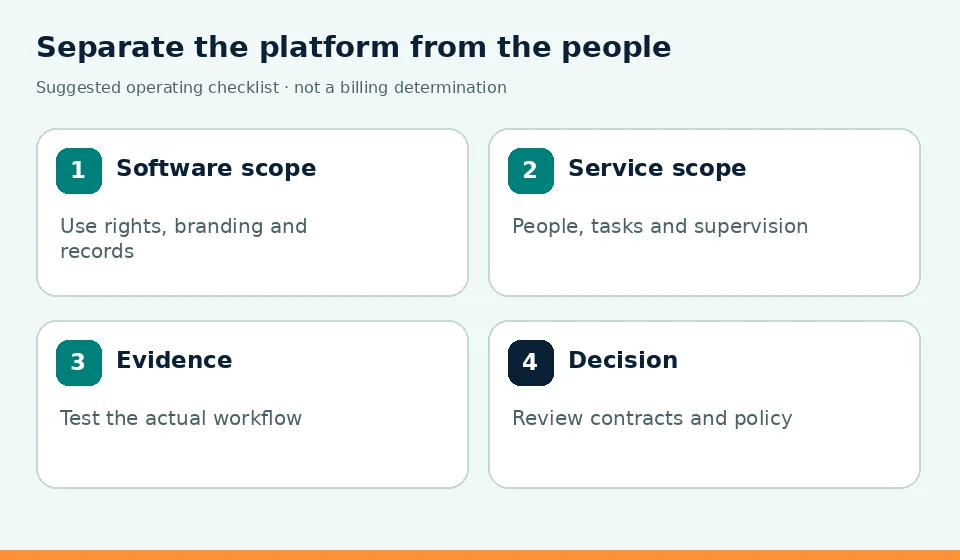
No. White-label software describes a branding and platform arrangement, while outsourced RPM care describes who performs services. A practice or RPM business should review those decisions separately. Specify the staff model, software rights, record access and operational responsibilities in the scope instead of treating a branded application as a complete service definition.
A device vendor can supply equipment while the practice runs the clinical workflow. A platform license can support practice staff without transferring the clinical service to the software company. Conversely, an offer described as a technology package may also include people performing patient-facing tasks. Read the scope rather than relying on the product name.
PCL Health offers white-label, licensing and acquisition discussions. The partners page describes the platform, patient app, Care Circle app, AI calls and billing module included in that discussion. Explore the Partners page.
What records and AI boundaries should buyers test?
Test the evidence a reviewer will need, not just the number of calls or readings shown on a demonstration screen. Ask how staff activity and patient communication are distinguished. An automated AI call supports follow-up and must not be presented as fulfilling qualifying interactive communication; that boundary belongs in both training and review. CMS CY 2021 final-rule fact sheet, 2020
Give the vendor a hypothetical patient with a missed reading, an automated reminder and a later staff conversation. Ask your vendor to show the separate events. The exercise should reveal what the software currently records and what the practice would need to document through its own procedure.
Also test an exception: a failed transmission, an unreturned call or an activity correction. Your aim is to understand who sees the problem and who can resolve it. Avoid requesting real patient data for procurement demonstrations when a suitable sample record can show the workflow.
What is a sensible decision process while policy is pending?
Document the current model, compare alternatives and prepare a decision gate for the final rule. Keep commercial commitments proportionate to what has been verified. Assign a person to review rule changes, another to evaluate the operating impact and a clinical lead to approve workflow changes before the practice changes its patient-facing service.
The proposal also includes an initiating visit, and CMS seeks comment on RPM and RTM code consolidation. CMS proposed-rule fact sheet, July 14, 2026 These issues should be included in the change register alongside staffing, rather than using one proposed change as the entire basis for a procurement decision.
Ask what can be changed by configuration, what requires supplier development and what requires a contract amendment. Keep those answers separate from promises about reimbursement. The related licensing guide and launch plan offer complementary checklists for defining the platform scope and the practice's operating responsibilities.
- Describe the present service and employment arrangements.
- Map the target workflow and compare alternatives.
- Obtain appropriate advice on unresolved responsibilities.
- Review the final rule before approving affected changes.
- Test records, train staff and document the decision.
Frequently asked questions
Does outsourced RPM always mean an outside clinical team?
Not necessarily; commercial packages differ. Ask which services and personnel the offer includes, then review the actual staffing arrangement rather than the label.
Should software licensing be reviewed separately from staffing?
Yes. Define platform rights and technical responsibilities separately from the people performing services. That distinction makes the operating and contract review more precise.
Does an in-house label prove the program meets requirements?
No. The practice still needs to review the actual work and supporting records. Assign responsibility for the review rather than assuming the organizational label answers it.
What should you ask a vendor before changing the contract?
Ask for a task-level scope showing which work the vendor’s staff currently perform. Agree which software, device and support services you would retain if your own employees took over clinical monitoring.
Sources
- CY 2021 PFS final-rule fact sheet; Remote Physiologic Monitoring Services — CMS CY 2021 final-rule fact sheet, 2020.
- CMS-1848-P regulation notice — CMS regulation notice, 2026.
- CY 2027 PFS proposed-rule fact sheet; Remote Monitoring — CMS proposed-rule fact sheet, July 14, 2026.
- CY 2027 PFS proposed rule, CMS-1848-P; section II.E.48, pages 148–158 of display PDF — CMS CY 2027 proposed rule, 2026.
- PFS Federal Regulation Notices — CMS rule notices.
This article is general information, not billing or legal advice. Confirm current payer requirements before submitting claims.