
Codes and insurance
Review CPT codes per patient and insurance details captured at enrollment.
How does PCL Health support RPM billing? PCL Health supports RPM billing documentation with CPT codes per patient, time tracking, audit logs and brief or detailed summaries for a selected date range. PCL Health documentation supports billing review and does not establish eligibility or guarantee reimbursement. Billing teams review eligible activity, communication and payer requirements before submitting claims.
Last updated:
RPM BILLING OVERVIEW
PCL Health maps RPM activity to CPT codes and provides brief and detailed summaries for any date range. Your billing team reviews the record and eligibility.
Book a demo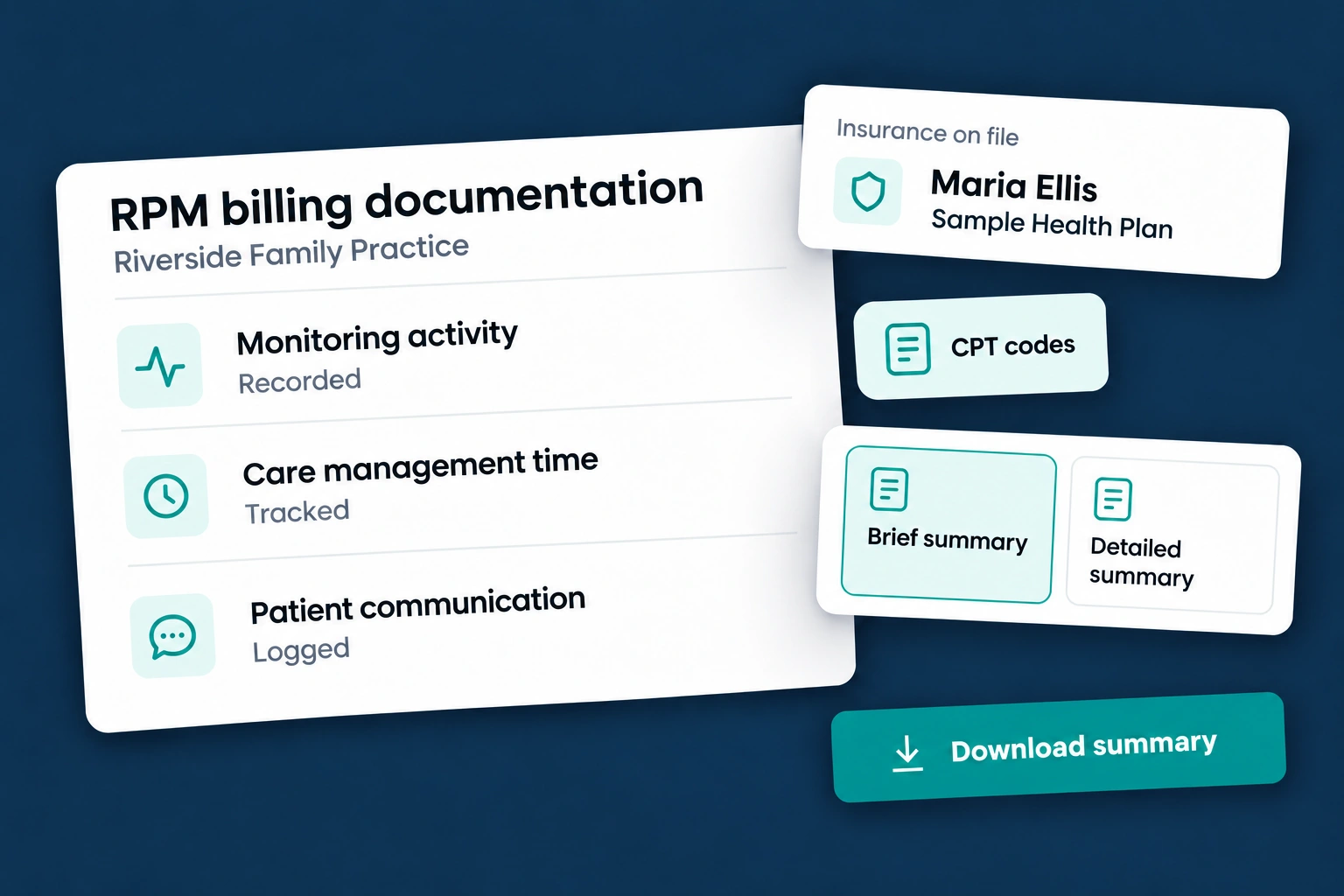
CPT CODES
| CPT code | Plain-English overview | PCL Health documentation support |
|---|---|---|
| 99453 | Initial device setup and patient education | Enrollment, consent, device registration and clinical notes support the setup record. |
| 99454 | Device supply and monitoring data over a 30-day period; the 16-day data threshold applies to this code | Vital trends and downloadable reports support review of the monitoring record. |
| 99457 | First 20 minutes of monthly RPM treatment management, including required interactive communication | Time tracking, communication records, notes and summaries support review of eligible activity. |
| 99458 | Each additional 20 minutes of monthly RPM treatment management, reported with 99457 | Date-range summaries and activity logs support review of additional eligible time. |
PCL Health currently maps these four codes. Other codes, including 99445 and 99470 introduced for 2026, and payer rules may apply.
Sources: CMS CY 2026 Physician Fee Schedule final rule (remote monitoring, pages 332–336), HHS RPM billing guide and CMS remote monitoring guidance.
DOCUMENTATION SUPPORT
Review CPT codes per patient and insurance details captured at enrollment.
Track time and download brief or detailed summaries for the chosen date range.
Review recorded activity alongside the clinical record.
AI follow-up calls and their duration are not automatically eligible clinical time or a substitute for required practitioner or clinical-staff communication. Confirm eligible staff time, communication and other payer requirements before billing. Do not count the same time toward RPM and CCM.
ILLUSTRATIVE REVENUE CALCULATOR
Choose a patient count and enter your own monthly reimbursement assumption.
Illustrative. Actual reimbursement varies by payer and eligibility.
Enter recurring reimbursement only. One-time setup fees are excluded.
BUYER QUESTIONS
PCL Health describes documentation support alongside CPT codes 99453, 99454, 99457 and 99458. Other codes and payer requirements may apply to the services being reviewed.
PCL Health provides brief and detailed billing summaries for any selected date range. Your billing staff can review these summaries alongside tracked activity and audit logs.
PCL Health documentation supports billing review and does not establish eligibility or guarantee reimbursement. Billing teams must review eligible activity, communication and payer requirements.
The PCL Health calculator multiplies the chosen patient count by a monthly rate entered by the visitor. The PCL Health annual estimate multiplies that monthly result by twelve, and actual reimbursement varies by payer and eligibility.
LET’S CONNECT
FROM INSIGHTS
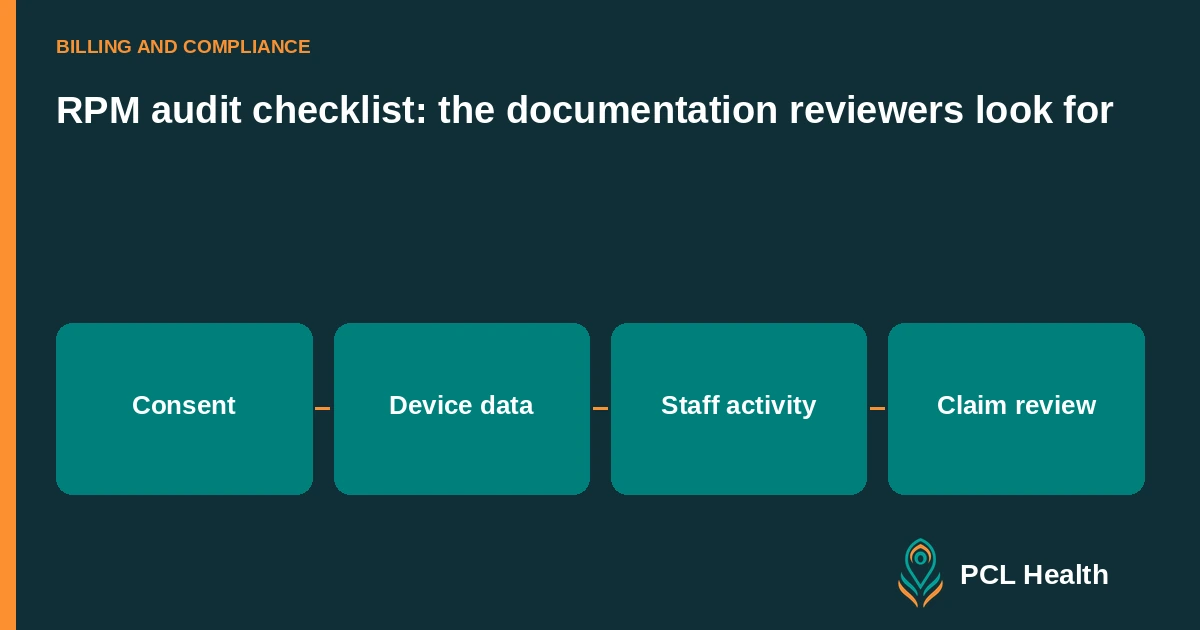
Use an RPM audit checklist to review consent, device data, staff time and interactive communication before billing. Includes CMS and OIG sources.
Read article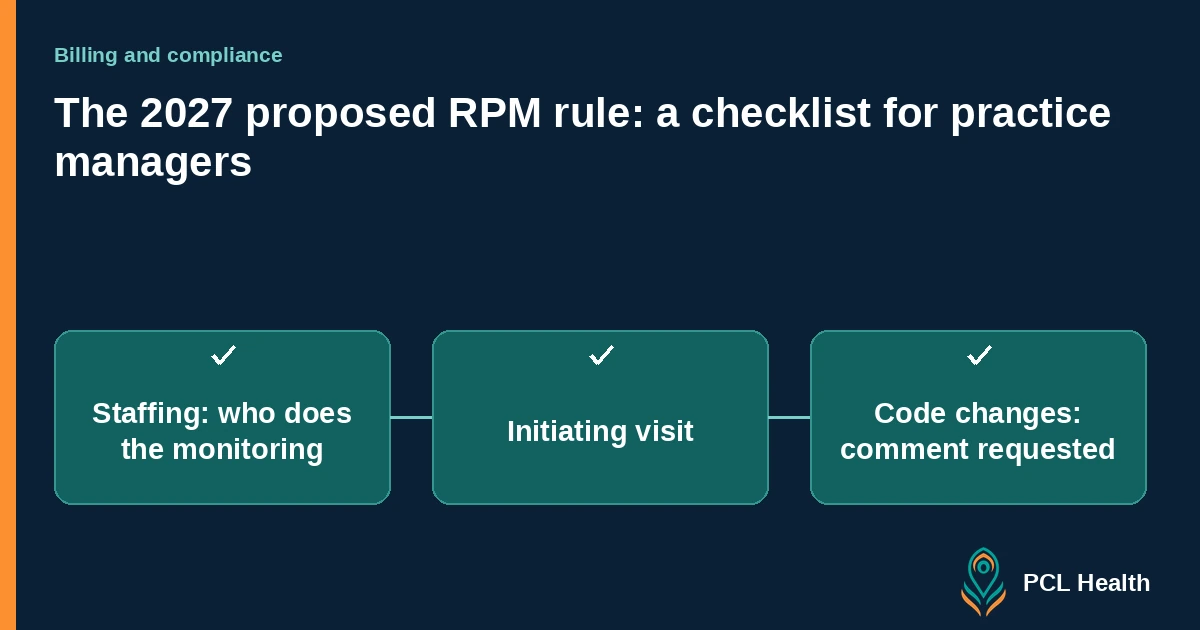
Practice managers should prepare a staffing map, an onboarding review and a final-rule update plan for the proposed 2027 RPM changes. The proposal is not a reason to treat future requirements as effective today.
Read article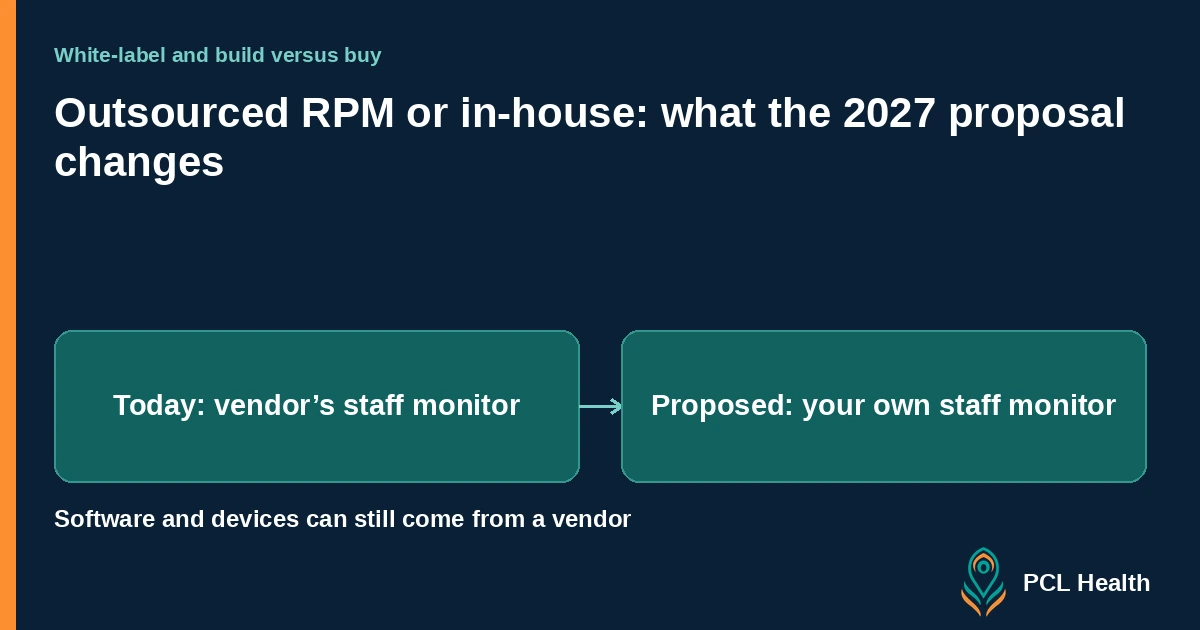
The proposed 2027 RPM policy makes employment arrangements a planning question when comparing outsourced and in-house programs. It does not make a delivery model compliant simply because it is called in-house, or make software licensing the same thing as outsourced clinical services.
Read article