
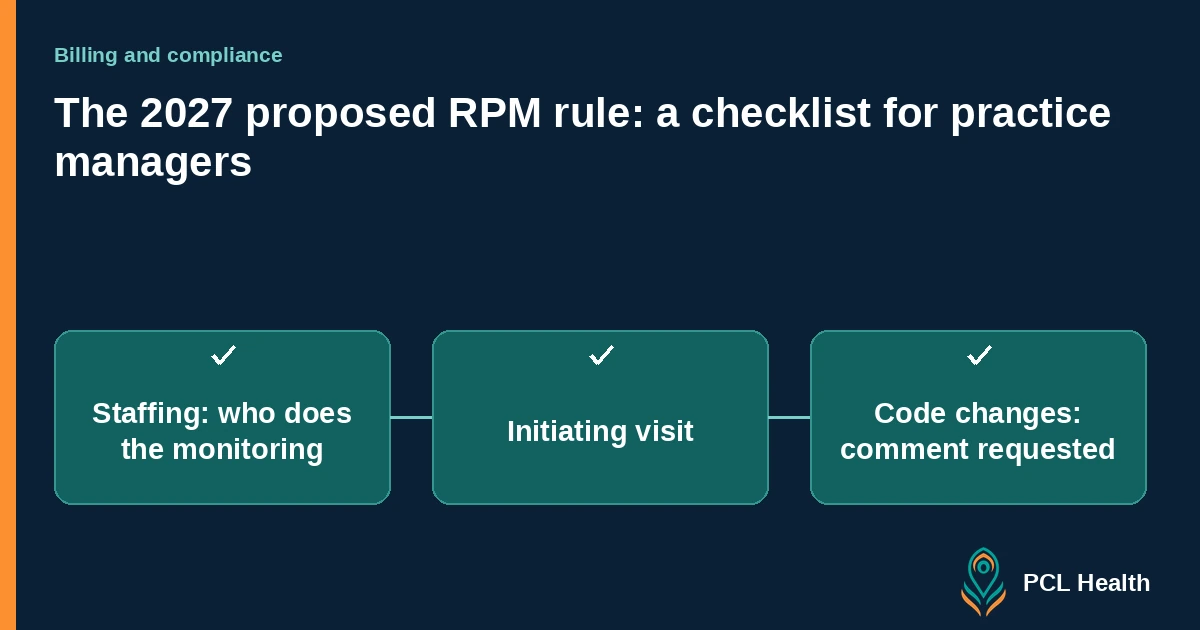
Practice managers should prepare a staffing map, an onboarding review and a final-rule update plan for the proposed 2027 RPM changes. The proposal is not a reason to treat future requirements as effective today. CMS proposed-rule fact sheet, July 14, 2026
Which parts of the 2027 proposal matter to practice managers?
Focus on the proposed staff-employment restriction, proposed initiating visit and the code-consolidation comment solicitation. CMS CY 2027 proposed rule, 2026 Then map the operational questions each raises for your practice. Treat the result as a contingency checklist that management can revise when the final rule is available, rather than a new billing instruction for current services.
Plan around January 1, 2027 as the proposed start date for the staffing change, subject to finalization. CMS CY 2027 proposed rule, 2026 The September 14, 2026 comment deadline has passed. CMS regulation notice, 2026 CMS also proposes reducing payment valuations for some remote monitoring codes through revised device-supply inputs and removal of practice-expense inputs for treatment-management codes. CMS CY 2027 proposed rule, 2026 CMS proposed-rule fact sheet, July 14, 2026 Your practice could still purchase software, devices and platforms from vendors while directly employed clinical staff deliver the services; the proposed staffing clause focuses on who provides clinical services. CMS CY 2027 proposed rule, 2026
Review two budgets before you commit to a staffing change: one using current payment assumptions and one allowing for the proposed valuation changes. Include nurse coverage, onboarding time, device costs and the software contract. Keep the final-rule review as the approval point for your revised operating plan.
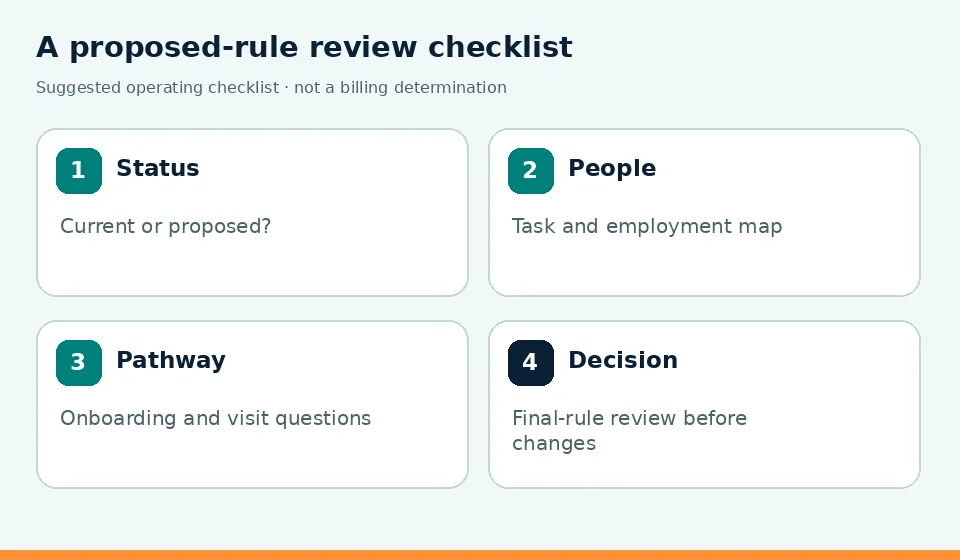
Start with a one-page change register. Give each issue a status, source, owner and next decision. Suggested statuses are current requirement, proposal, awaiting final review and approved operational change. Link each issue to its source and record the decision your team needs to make.
CMS displayed the proposed rule on July 14, 2026; the regulation notice gives July 16 as the publication date. CMS regulation notice, 2026 Keep those dates distinct when staff refer to the rule. Assign one person to check the final rule and update your procedures.
How should the staffing review be organized?
List every monitoring task and the person who performs it, then record the person's employer and responsible supervisor. Check the employment arrangement behind each task before you decide which roles would need to move. Include backup coverage, staff training and the handoff to the clinician who makes care decisions.
Work through a normal Tuesday. Who notices missing readings, contacts the patient, checks the incoming data, handles a question and records the work? If the answer is only a company name, keep asking until the task has a named responsible role.
Bring ambiguous employment arrangements to an appropriate adviser. A contract label alone is not enough to settle how a future finalized policy would apply. Avoid promising that a revised commercial agreement will preserve payment before the practice has assessed the actual service arrangement.
Consider a cardiology practice whose RPM vendor’s nurses currently review transmitted blood pressure and weight readings, call patients and send issues to the practice. If the proposed staffing restriction is finalized as drafted, the practice would need directly employed clinical staff to perform the monitoring services for Medicare payment. CMS CY 2027 proposed rule, 2026 Map those nursing tasks now, identify the practice nurse who could take them over and agree how open issues would transfer. Keep the software and device supply in a separate contract discussion.
| Checklist item | Record to collect | Decision owner |
|---|---|---|
| Task allocation | Named role for each monitoring task | Practice manager |
| Employment arrangements | Current contractual and staffing description | Management and adviser |
| Backup coverage | Absence and handoff plan | Clinical lead |
| Record access | Who can retrieve each service record | Operations lead |
What should the practice prepare for an initiating visit?
Prepare a draft pathway showing who schedules the visit, who assesses the patient, where the monitoring discussion is recorded and how onboarding follows. Under the proposal, initiation would occur in a separately reportable face-to-face visit, in person or by telehealth. CMS CY 2027 proposed rule, 2026 Have the clinical and billing leads review the pathway before implementation.
Look for the operational gap between a clinician's decision and device training. An appointment may be recorded in one place while the setup team works from another list. Your draft pathway should show how the team recognizes that the clinical step has occurred without guessing from a referral or an appointment booking.
Do not automatically add visits to every current patient's schedule on the strength of a proposed policy. Prepare the questions for final-rule review, including how initiation is described and what implementation instructions apply.
How should a practice prepare for possible code consolidation?
Preserve the underlying service categories even if the reporting structure changes later. Keep setup, device data, activity and communication distinguishable in reports. The G-code approach is a CMS comment solicitation, not an adopted replacement code set. CMS proposed-rule fact sheet, July 14, 2026 Ask vendors how reporting could be revised without losing the history needed for review.
At a demonstration, ask to see how a record is retrieved by patient and date range. Then ask what happens to historical records after a reporting change. A vendor's answer should describe its current capability and its proposed change process separately.
Give your vendor a list of reports to update and agree who will test them. Record which reports would need attention and who would test them. Do not assign invented codes or build a submission policy around placeholder labels.
What should happen before a new procedure is approved?
Use a short approval checklist covering the source, affected tasks, staff instruction, reporting changes and patient communications. Keep the present process active until a replacement has been reviewed for the applicable effective date. Ask the people doing the work to test the new procedure using a hypothetical record before rollout.
Include the AI boundary in that test. An automated AI call supports follow-up; it should not be treated as meeting qualifying interactive communication. CMS describes a real-time, two-way conversation for 99457 and 99458. CMS CY 2021 final-rule fact sheet, 2020 A reminder event and the later staff conversation need distinguishable records.
PCL Health provides a clinician workspace, care plans and AI call summaries. The clinics page shows the workflow the platform supports. Use a demonstration to examine the records, while leaving rule interpretation and submission decisions with the practice's clinical and billing teams. Explore the For clinics page.
- Assign the policy-review owner.
- Collect staffing and onboarding questions.
- Compare the final rule with the proposal.
- Review effective dates and payer instructions.
- Approve, train and test the revised procedure.
Frequently asked questions
Does the proposed rule apply as final policy now?
No. The CMS regulation notice identifies it as a proposed rule. Use the dated update note and the primary sources to distinguish this draft policy from current requirements. CMS regulation notice, 2026
Should the practice cancel outsourced services immediately?
Review your current contract, task allocation and staffing arrangements before changing the service. Prepare a transition plan you can approve after reviewing the final rule.
Can an AI call replace the staff communication step?
Do not count an automated AI call as satisfying that step. Keep reminder events and clinical conversations distinguishable in the program record.
What should a manager ask the software vendor?
Ask how patient records, activity reports and communication records can be retrieved and revised when requirements change. Request a demonstration of current capabilities and a separate explanation of the vendor’s change process.
Sources
- CY 2021 PFS final-rule fact sheet; Remote Physiologic Monitoring Services — CMS CY 2021 final-rule fact sheet, 2020.
- CMS-1848-P regulation notice — CMS regulation notice, 2026.
- CY 2027 PFS proposed-rule fact sheet; Remote Monitoring — CMS proposed-rule fact sheet, July 14, 2026.
- CY 2027 PFS proposed rule, CMS-1848-P; section II.E.48, pages 148–158 of display PDF — CMS CY 2027 proposed rule, 2026.
- PFS Federal Regulation Notices — CMS rule notices.
This article is general information, not billing or legal advice. Confirm current payer requirements before submitting claims.