
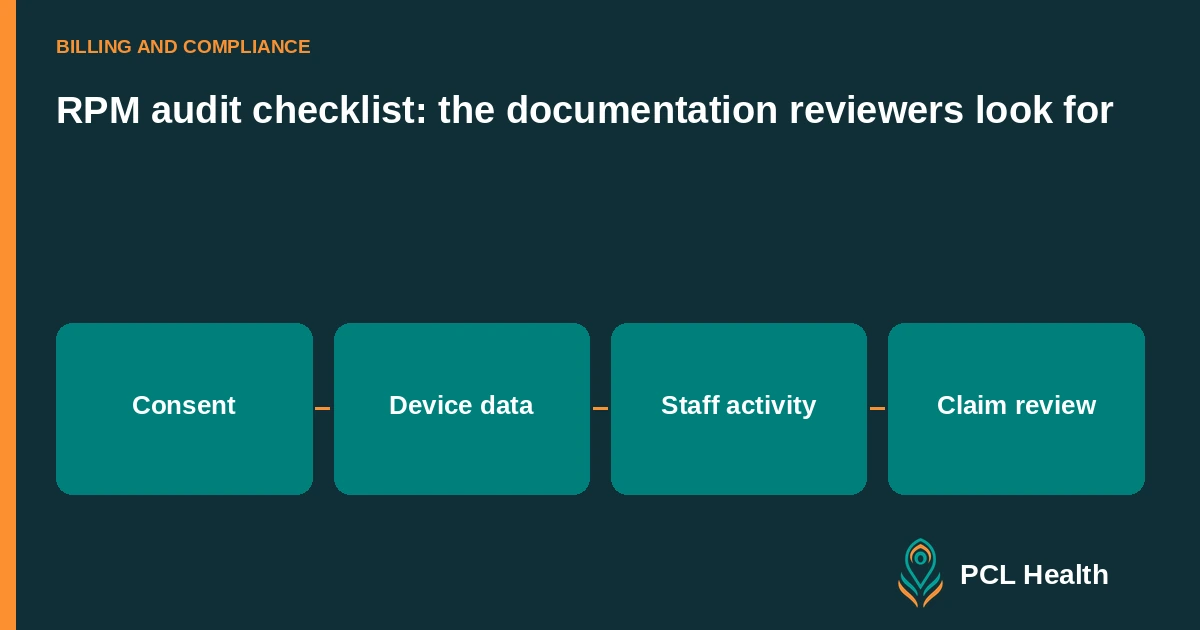
An RPM audit checklist helps you connect each billed service to evidence of patient consent, medical necessity, device data and the work your team performed. Start with the claim, then trace it back to the patient record, the transmission history and the staff activity log.
Use this suggested checklist before billing and when testing whether your records can answer an external request. For the wider code and policy context, read the RPM billing requirements guide.
What should you put in the review packet?
Put the claim details, the reason for monitoring, consent, setup documentation, transmitted readings and treatment-management records in one review packet. Give each item a patient identifier and the relevant service period. Your reviewer should be able to follow the work without asking the care coordinator to reconstruct the month from memory.
CMS describes three RPM components: education and setup, device supply, and treatment management. Use those components to organize your evidence, while reviewing the requirements for each code individually. CMS RPM overview (2026).
| Review area | Evidence to assemble | Question to resolve |
|---|---|---|
| Patient and purpose | Clinical record and consent entry | Why was monitoring started, and did the patient agree? |
| Setup | Device assignment and education note | What was supplied and explained? |
| Device data | Transmission history for the service period | Which days contain transmitted readings? |
| Treatment management | Staff activity, time and conversation notes | Who did what, and what followed? |
| Claim | Selected codes, periods and supporting records | Does the evidence support each billed service? |
How do you document medical necessity and consent?
Keep the clinical reason for monitoring and the consent entry easy to find. The record should explain which condition the practitioner is monitoring and why RPM is appropriate for that patient. For consent, identify when the patient agreed, who recorded the agreement and where your reviewer can retrieve the entry.
CMS requires medically reasonable and necessary monitoring, an established patient relationship and consent when RPM services are provided. CMS MLN guidance (December 2025). A device shipment alone does not explain the clinical purpose.
When your coordinator opens a new enrollment, ask whether the reviewer can connect that enrollment to the practitioner's assessment. Keep unresolved consent questions in a named person's queue rather than burying them in a general enrollment note.
What proves that readings were collected and transmitted?
Use the actual transmission history, with the patient, device and service period identified. Count the days with data against the selected code's requirements, and investigate gaps between a device assignment and the readings received. A list of enrolled patients or a device delivery receipt cannot answer those questions by itself.
The day threshold depends on the code. CMS distinguishes 2–15 days from 16 or more days within 30 days, and requires electronic collection and automatic upload. CMS MLN guidance (December 2025).
For a patient with two devices, make the combined timeline understandable. Repeated measurements on one day should not become extra days in your count. Ask the reviewer to confirm the service period before comparing a monthly dashboard total with the claim.
What should treatment-management notes show?
Make the notes identify the staff member, the activity, the time spent and the connection to the patient's monitoring. Keep the live conversation identifiable within that record. A monthly total is easier to review when you can trace its entries to the work, rather than relying on a single unexplained number.
CMS explains that 99457 and 99458 include care-management time and require real-time, two-way interactive communication. CMS CY 2021 final-rule explanation. Automated AI calls support the program; do not treat them as meeting that requirement.
Keep a voicemail attempt separate from a completed conversation. If an entry says only “called patient,” return it to the responsible staff member for clarification. The interactive communication guide explains how to distinguish the activities.
PCL Health provides time tracking and billing summaries for review. See how the RPM billing module organizes the documented work.
Which billing patterns deserve a closer look?
Review repeated device charges, patients who appear in more than one practice's monitoring program and enrollments with an unclear clinical relationship. Ask whether the records explain the pattern before reaching a conclusion. Use the finding to select records for closer review and to identify the person who will resolve the discrepancy.
OIG's 2025 analysis identified practices warranting scrutiny through patterns including multiple-device billing and patients without prior practice history. The report states that these measures do not prove fraud or a billing violation. OIG RPM billing report (2025).
OIG's 2024 report also raised concerns about incomplete monitoring components. OIG oversight report (2024). A useful internal question is simple: can your team show the service behind the charge?
How do you check for overlapping care-management time?
Compare the underlying activity entries across the patient's care-management services before accepting the monthly totals. Identify the staff member, date, task and duration of each entry, then resolve any duplicate allocation. Have the reviewer ask about ambiguous entries while the work is still fresh enough for staff to explain accurately.
CMS permits concurrent RPM and certain care-management services, including CCM, when time and effort are not counted twice. CMS MLN guidance (December 2025). Keep the review at the activity level so two summaries do not conceal the same work.
What should your checklist track for the 2027 proposal?
Keep a separate change log for the proposed staffing and initiating-visit requirements. Identify whose staff currently perform monitoring, how the practice starts the service and which records would need to change if the proposals are finalized. Keep your current claim review tied to the rules applicable to its service period.
For CY 2027, CMS proposes payment only when monitoring is performed by clinical staff employed by the practice, rather than contractors, and a separately reportable initiating visit. CMS also seeks comment on consolidating RPM and RTM codes into four G-codes. These remain proposals. CMS proposed-rule fact sheet (2026); CMS proposed-rule record (2026). Federal Register proposed rule (2026).
How do you turn findings into a repeatable process?
Assign an owner to each unresolved finding and record the next action. Separate a missing document from an unsupported service so your team responds to the actual problem. Repeat the same review steps on later records, and check whether the process change fixes the gap instead of merely completing one patient's packet.
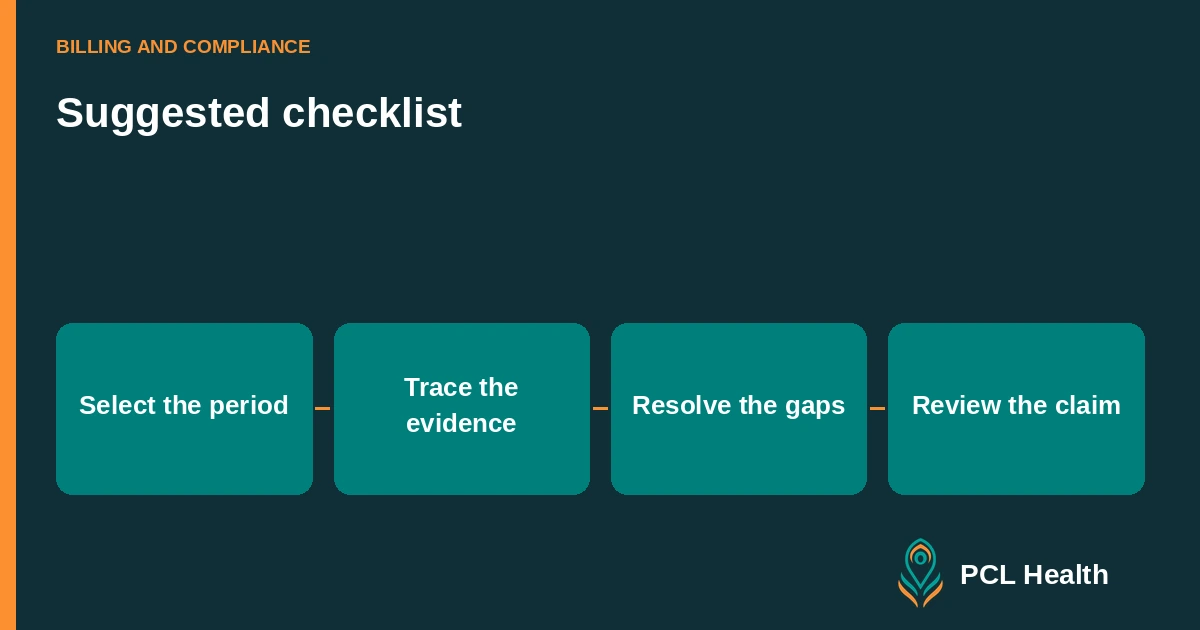
- Select a patient and service period.
- Trace each claim line to its supporting record.
- Record the gap, responsible person and next action.
- Resolve questions before releasing an unsupported item for billing.
- Review another record using the corrected process.
For a practical way to assign the work, use the RPM staffing guide. Give your reviewer a complete record and a clear route for questions.
Main guide: RPM billing requirements
FAQ
Does an RPM checklist guarantee that a claim will be paid?
A checklist helps organize evidence for billing review. Your billing staff must still confirm eligibility and the requirements applicable to the service period.
Does an automated AI call meet RPM interactive communication requirements?
An automated AI call supports the program and should not be treated as qualifying interactive communication. CMS describes the requirement for 99457 and 99458 as a real-time, two-way exchange. CMS CY 2021 explanation.
What should you review when a patient has more than one device?
Check the combined transmission history and the device-related claim lines. OIG identifies repeated billing for multiple devices as a pattern that warrants scrutiny, rather than proof of a violation. OIG report (2025).
What documentation does PCL Health provide for review?
PCL Health provides time tracking and billing summaries. Those records support billing review and do not establish eligibility or guarantee reimbursement.
Sources
- CMS: Remote patient monitoring (2026)
- CMS: Telehealth and remote monitoring (December 2025)
- CMS: CY 2021 final-rule explanation
- OIG: Billing for remote patient monitoring in Medicare (2025)
- OIG: Additional oversight of remote patient monitoring (2024)
- CMS: CY 2027 proposed-rule fact sheet (2026)
- CMS: CY 2027 proposed-rule record (2026)
- Federal Register: CY 2027 proposed rule (2026)
This article is general information, not billing or legal advice. Confirm current payer requirements before submitting claims.