
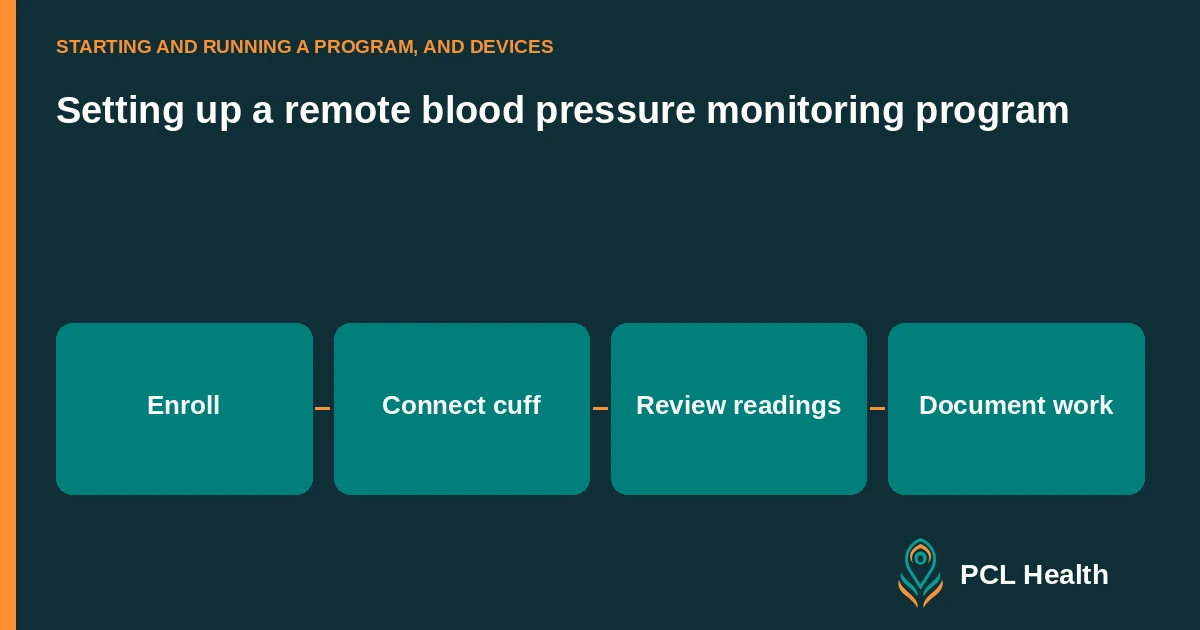
Set up a remote blood pressure monitoring program by defining patient selection, device onboarding, reading review, follow-up and documentation before enrollment starts. Give each task a named owner and test the complete path from the patient's cuff to the clinic's record.
This is a suggested operating checklist for a practice launching the workflow. Your clinical lead sets the measurement instructions, thresholds and response protocol. The 90-day RPM program guide explains how to sequence the broader launch.
What should your practice decide before enrolling patients?
Agree the purpose of the program, who can enroll a patient and how the team will review transmitted readings. Identify the clinician responsible for the monitoring plan and the coordinator responsible for setup. Write down the handoffs so staff know when an enrollment is ready to move into routine monitoring.
HHS recommends defining team responsibilities, enrollment criteria and follow-up workflows when designing RPM. HHS strategy guidance (2026). Use a small operating map that staff can read during a busy clinic session.
Start with the staff work you can support. Decide who reviews the queue during the clinic's stated service hours, who covers absence and where unresolved questions go. Test that plan with a pretend enrollment before assigning devices to patients.
How should you select and assign the cuff?
Have the clinical lead approve the device selection and patient-use instructions, then test the connection with the equipment your program will supply. Record which cuff belongs to which patient. Your setup team needs a repeatable way to pair the device, confirm receipt of a reading and route questions about use or suitability.
CMS describes RPM using a connected medical device that automatically transmits physiologic data to the provider. CMS RPM overview (2026). Device suitability and the measurement protocol belong with the responsible clinician.
For a Bluetooth workflow, test pairing on the patient's phone and document who will help if the connection fails. Keep a record of replacement assignments so your team does not investigate readings against an outdated device record.
What belongs in the enrollment handoff?
Give the monitoring team the patient record, consent status, assigned device, clinician-approved reading routine and contact arrangements. Confirm the first transmitted reading before closing the setup task. List any remaining barrier with an owner so the receiving team can see whether the patient is ready for routine monitoring or still needs support.
| Workflow task | Suggested owner | Evidence of completion |
|---|---|---|
| Confirm enrollment | Clinical lead and coordinator | Monitoring purpose and consent status recorded |
| Assign and connect cuff | Setup lead | Device linked to the patient and first reading received |
| Review readings | Monitoring lead | Review and next action documented |
| Resolve missed readings | Patient-support lead | Barrier, response and follow-up owner recorded |
| Prepare billing review | Billing reviewer | Service period and supporting records reconciled |
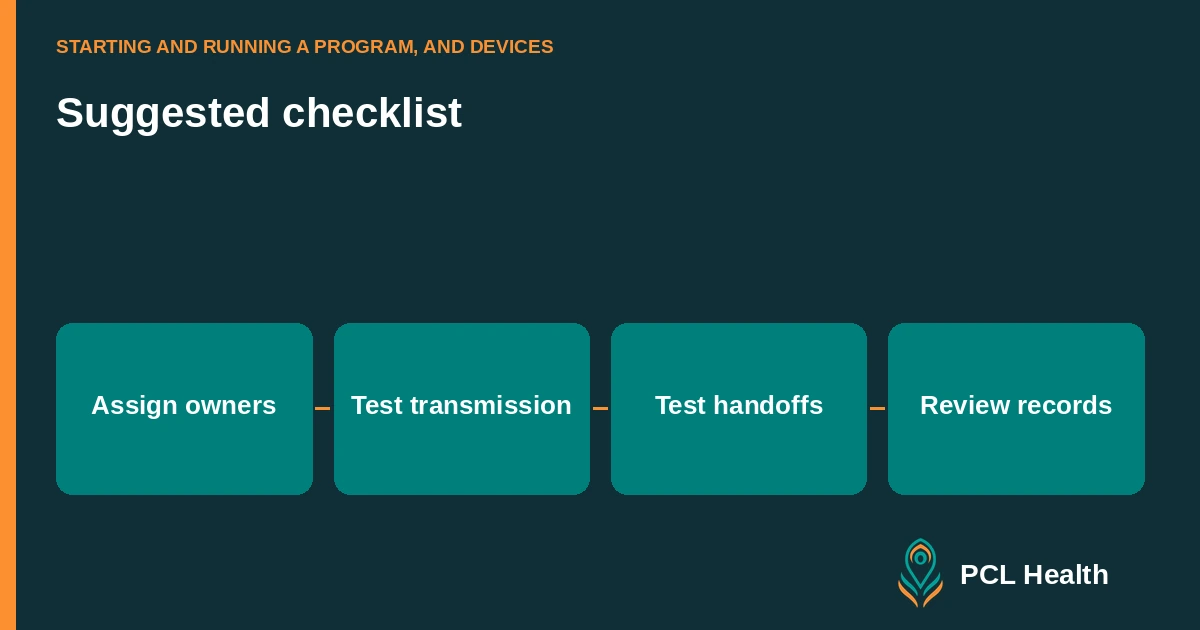
HHS recommends confirming to the patient that the first information was received. HHS preparation guidance (2026). The patient onboarding guide gives you a week-one checklist.
How should you organize reading review and alerts?
Have the clinical lead define the reading-review routine, alert thresholds and response protocol, then make the assignment visible to the team. Each alert needs an owner, a route for clinical questions and a documented next action. Test what happens when the usual reviewer is absent or the patient cannot be reached.
A useful test asks operational questions: who sees the item, who acts on it, who records the outcome and who checks that the next step happened? Run that sequence with your actual staffing arrangements. An alert arriving in a queue is only the start of the task.
PCL Health includes vitals trends, care plans, alerts and notes in the clinician workspace. Explore the Product page for how the modules connect the monitoring workflow.
Give patients the practice's approved reading and contact instructions. Match the explanation to the service your team actually provides, including the route for urgent concerns and after-hours questions.
How should missed readings enter the workflow?
Give missed readings a defined trigger, a staff owner and a route for resolving the patient's barrier. Establish whether the patient has taken a measurement and whether the reading reached the clinic before deciding on the next contact. Keep the outcome visible so the next coordinator does not repeat the same unanswered question.
A patient who needs pairing help has a different next step from a patient who needs the instructions explained again. Keep the question concrete: did the measurement happen, did the app receive it and can the clinic see it?
Automated AI calls support follow-up and reminders. They should remain distinguishable from staff conversations and should not be presented as meeting RPM interactive communication requirements. CMS describes that requirement for 99457 and 99458 as real-time, two-way communication. CMS CY 2021 explanation.
What should your records support at month end?
Keep the transmitted-data history, staff activity and follow-up notes linked to the correct patient and service period. Your reviewer should be able to see the work behind each proposed charge. Resolve unclear time entries and missing records before the affected item reaches billing rather than using a monthly total to fill the gap.
CMS distinguishes data-day requirements from treatment-management requirements in its remote-monitoring guidance. CMS MLN booklet (December 2025). Your billing team should review the selected code and applicable payer requirements.
The RPM audit checklist shows how to assemble that packet. A clear record supports billing review and does not establish eligibility or guarantee reimbursement.
What should you test before expanding the program?
Review whether the team can complete setup, receive readings, handle missing data and document the next action with the staffing available. Look at unresolved tasks as well as completed enrollments. Ask the people doing the work which handoff creates confusion, then change that step and test it again before expanding.
- Confirm the patient can repeat the setup routine.
- Confirm the clinic receives the reading in the correct record.
- Test reviewer absence and an unanswered follow-up.
- Check that staff can retrieve the consent and activity records.
- Resolve open tasks and repeat the affected handoff.
How does the 2027 proposal affect launch planning?
Plan a review point for the proposed initiating visit and employed-staff changes before committing to an expanded monitoring model. Map the people performing the work and how the service begins. Keep those proposed changes separate from the rules applicable today, and give someone responsibility for updating the workflow when the final rule is published.
The CY 2027 proposal would require an initiating visit and monitoring by clinical staff employed by the practice. CMS also sought comment on RPM and RTM code consolidation. These remain proposed changes. CMS fact sheet (2026); Federal Register proposed rule (2026).
Main guide: How to start an RPM program
FAQ
Who sets the reading routine and alert thresholds?
Your clinical lead sets the measurement instructions, thresholds and response protocol. The operating workflow identifies who reviews readings and who records the next action.
What should your practice test before launch?
Test device assignment, connection and receipt of a reading in the correct patient record. Also test reviewer absence, unanswered follow-up and retrieval of the supporting records.
What does the clinician workspace provide?
PCL Health includes vitals trends, care plans, alerts and notes in the clinician workspace. PCL Health connects those modules within the remote-monitoring workflow.
Do reminder calls replace qualifying interactive communication?
Automated AI calls support follow-up and reminders. CMS describes the requirement for 99457 and 99458 as real-time, two-way communication, so keep qualifying staff conversations separately documented. Source.
Sources
This article is general information, not billing or legal advice. Confirm current payer requirements before submitting claims.