
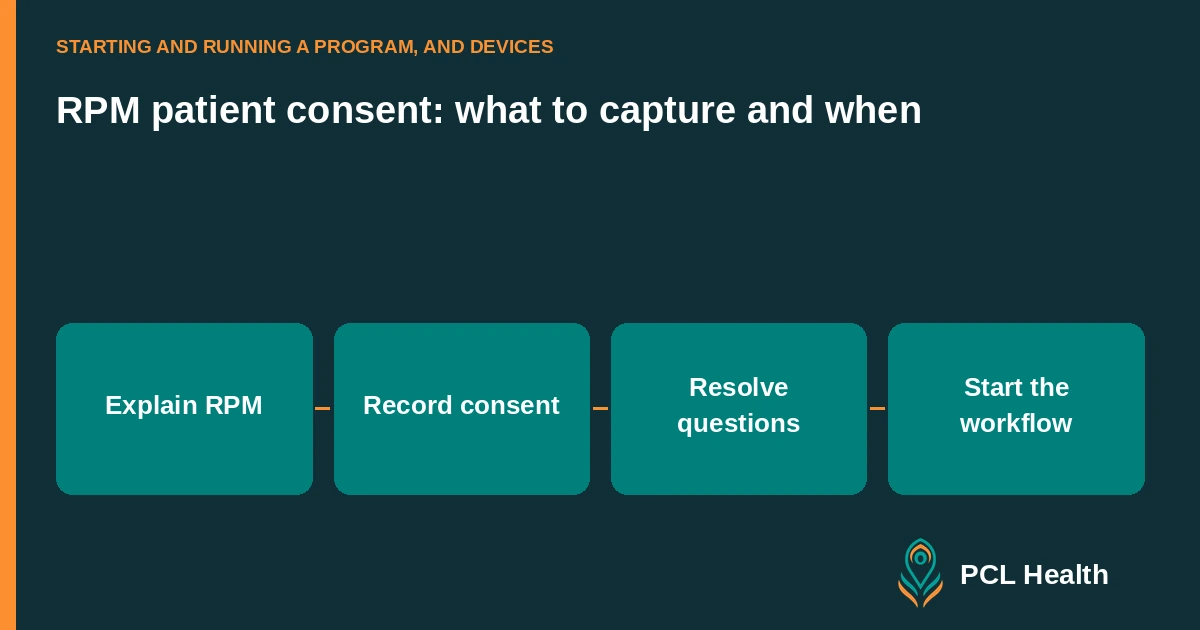
Capture RPM patient consent when the service is furnished, and keep the agreement retrievable in the patient record. Record what the patient agreed to, when the discussion happened and who documented it. CMS remote-monitoring guidance (December 2025).
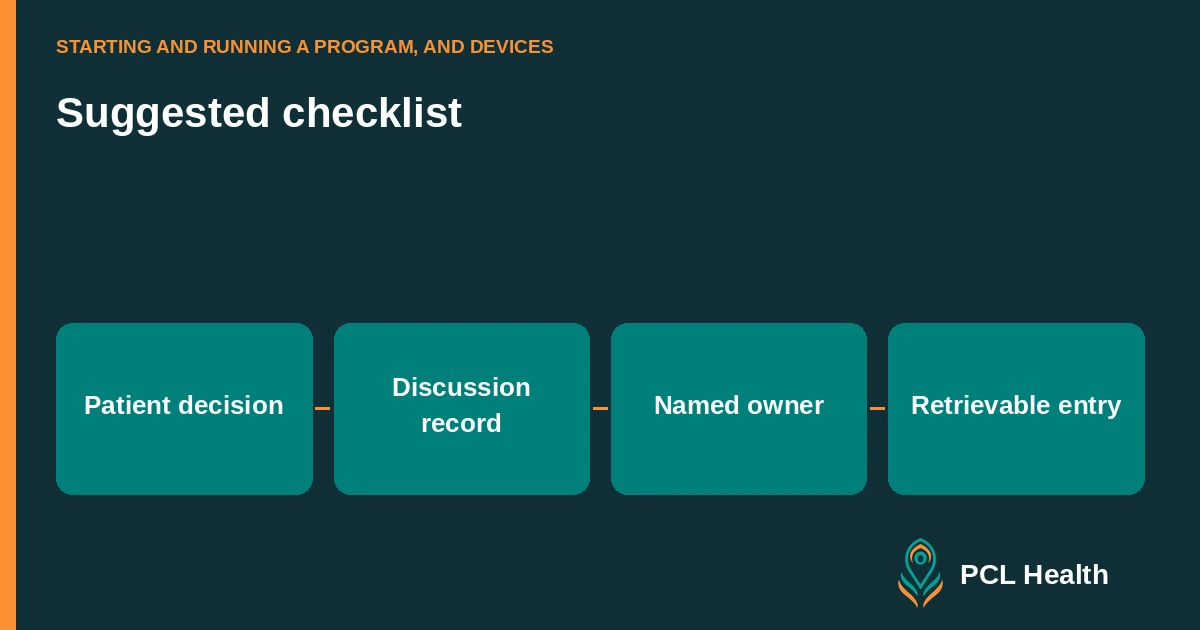
A useful consent entry also gives the next coordinator enough context to continue the conversation. Use this suggested operating checklist alongside your practice's approved process. The 90-day RPM program guide places consent within the wider launch workflow.
When should your team obtain RPM consent?
Make consent part of the start of the service, with a clear owner and a retrievable entry. Your team should be able to identify the discussion without searching through shipping records or reminder logs. If the patient has unanswered questions, record them and assign a next step before treating enrollment as complete.
CMS finalized that consent may be obtained when RPM services are furnished. CMS CY 2021 final-rule explanation. Put that step where it can actually happen in your workflow rather than assuming another team completed it.
For example, a coordinator arranging device setup can see whether consent has been documented and whether the patient still has questions about the program. A status flag is useful only if the underlying entry explains the status.
What should the consent entry contain?
Record the patient, service, date, person conducting the discussion and the patient's decision. Add a concise account of what was explained and any questions that remain open. Keep the entry in a place your clinical and billing reviewers can retrieve, using a consistent label that distinguishes consent from general enrollment activity.
| Suggested field | What it helps your team answer |
|---|---|
| Patient and RPM service | Whose agreement is recorded, and for which program? |
| Date and responsible person | When did the discussion happen, and who can clarify it? |
| Explanation provided | What did the patient understand about participation? |
| Patient's decision | Did the patient agree, decline or request more information? |
| Outstanding questions | What needs an answer, and who owns that follow-up? |
| Record location | Can the next reviewer find the original entry? |
Use your practice's approved wording and applicable payer requirements when choosing the final fields. The table gives you an operating structure; your reviewer still needs to assess the actual service and record.
What should you explain before asking for agreement?
Explain the program in everyday terms: which readings the clinic will receive, how the device sends them, who reviews them and how the patient gets help. Include the expected reading routine and the route for questions about costs. Invite the patient to explain the next step back to you before ending the discussion.
HHS patient guidance encourages people to ask about costs, device use, data sharing and whom to contact when technology fails. HHS patient RPM guidance. A short written reference can support the conversation after the patient gets home.
Avoid telling a patient that someone is watching every reading immediately unless that matches the actual service your practice provides. Give the patient the clinic's approved contact instructions and review arrangements. Clear expectations help the coordinator answer the same questions consistently.
Is a signed form the whole consent process?
Use the form or entry to record the agreement, and make the discussion understandable alongside it. Check whether the patient had questions, how they were answered and what participation involves. Your team needs enough context to continue care and explain the record; a completed document should not end an unresolved conversation.
The cited CMS RPM guidance establishes the timing of consent. It does not supply your practice's entire consent workflow. CMS MLN guidance (December 2025). Have your reviewer confirm the accepted method and applicable requirements before adopting a standard RPM consent form.
If a patient prefers a conversation to a digital form, route that request to the person responsible for your consent process. Record the outcome accurately rather than marking the patient complete because a form was sent.
How should family help and AI calls be explained?
Explain family involvement and automated follow-up as distinct parts of the program. Ask the patient who, if anyone, will help with devices or reminders, and follow your approved access process. Describe what an automated reminder does and which questions need a staff conversation, so the patient knows where to take unresolved concerns.
HHS describes family members helping patients with technology and routine device use. HHS patient-preparation guidance (2026). Keep the patient's participation decision clear even when a relative helps with setup.
Record the helper's role and the arrangements agreed with the patient. For example, help pairing a cuff is different from permission to receive clinical information. Follow the practice's access and consent process when those questions arise.
PCL Health manages intake and consent within the clinician workflow. Explore the Platform page to see how the information sits alongside care plans and patient notes.
What happens when a patient declines or wants to stop?
Record the patient's decision and route it to the person responsible for enrollment and ongoing service. Make the next action clear for staff handling devices, reminders and billing review. If the patient asks a question rather than giving a final decision, record that distinction and give the question an owner.
Use a short internal handoff: what the patient said, when it was recorded, who will respond and which activities need review. This avoids leaving one team calling a patient while another believes participation has ended.
When the record changes, retain enough context to show the sequence. Do not replace the earlier agreement with a bare “inactive” label that hides when the patient asked to stop or how the team responded.
What would the proposed initiating visit change?
Map your current consent step to the proposed initiating visit, while keeping the current and proposed requirements separate. Identify who would conduct the visit, where the monitoring discussion would be recorded and how the coordinator would see that record. This gives your practice a concrete planning task if the proposal is finalized.
For CY 2027, CMS proposes a separately reportable initiating visit for RPM and payment when services are performed by clinical staff employed by the practice. CMS also sought comment on code consolidation. These remain proposals. CMS fact sheet (2026); Federal Register proposed rule (2026).
Then test your current handoff with one enrollment: can the next staff member find the agreement, answer the patient's basic questions and explain the next step? Use the patient onboarding guide and the RPM audit checklist to connect consent with setup and review.
Main guide: How to start an RPM program
FAQ
When is RPM consent required?
CMS requires consent when RPM services are provided. Put the discussion and record in the enrollment handoff so the next team member can retrieve them. Source.
Does CMS supply a complete RPM consent form?
The cited CMS guidance states the timing requirement for consent. Have your reviewer confirm the accepted method and applicable requirements for your practice’s consent process. Source.
What should your team record when a patient declines?
Record the decision, the person responsible for responding and the next action. Keep reminders, device tasks and billing review informed of the change.
How does PCL Health support consent documentation?
PCL Health manages intake and consent within the clinician workflow. The information sits alongside care plans and patient notes.
Sources
This article is general information, not billing or legal advice. Confirm current payer requirements before submitting claims.