
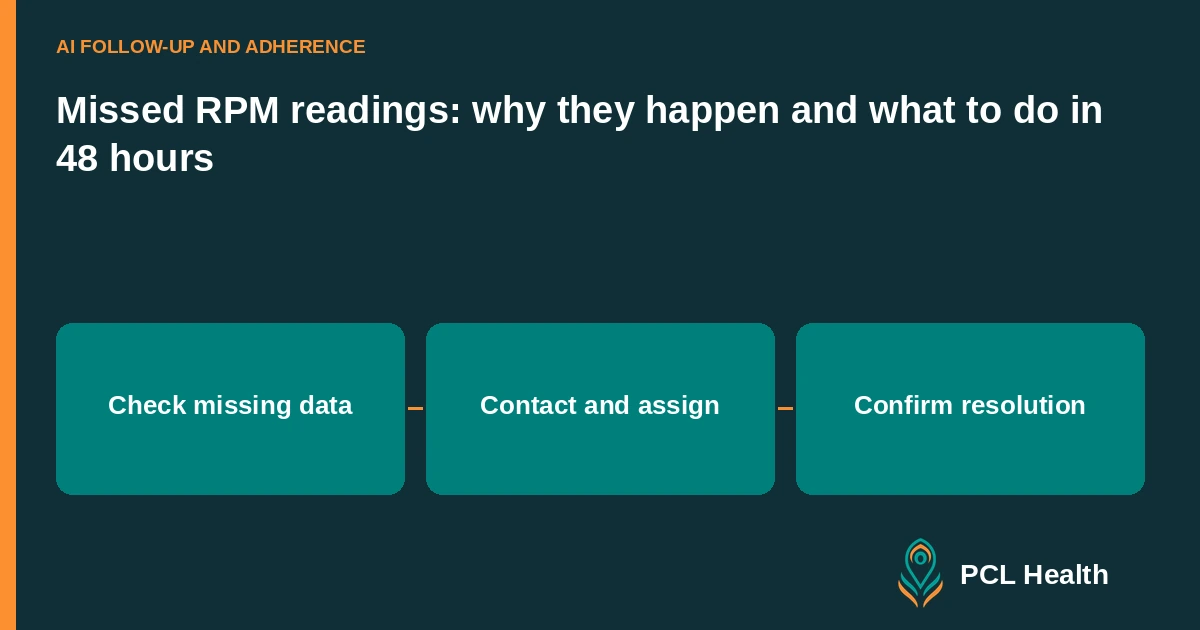
Missed RPM readings can come from a forgotten measurement, a device or transmission problem, or a change in the patient's circumstances. In the first 48 hours, confirm what is missing, contact the patient appropriately and give the unresolved issue a named owner.
Use the patient's agreed monitoring schedule as your starting point. A blank space in the workspace tells you that data is absent; it does not explain why. Check the measurement and transmission steps before deciding which follow-up will help.
What should you check before contacting the patient?
Confirm that a reading was expected and is absent from the record. Check the account, device assignment and last received timestamp. Look for a recent pause, changed instructions or an open technical issue. This first review helps you choose the right contact instead of sending a reminder for a problem the patient has already reported.
For an app-based device, a patient may have taken the measurement without completing the upload. Check what staff can see in the clinical workspace, then ask the patient about the device and app as appropriate. Keep the two events separate: taking a measurement and receiving its data.
HHS's patient RPM guidance recommends learning how readings are sent and asking the care team for help with device, app or internet problems. Use that distinction when deciding whether the first contact is a reminder or a support call.
Why do readings go missing?
Investigate the barrier rather than applying a single explanation. The patient may have forgotten the scheduled measurement, struggled with the device, lost the connection or changed their routine. Ask a focused question, record the answer and route the issue to someone who can resolve it. Keep clinical questions with the appropriate care team.
A cardiology patient may say, “I used the cuff, but the reading is still on my phone.” That calls for a transmission check. Another patient may have misplaced the device while traveling. A third may need the team to clarify the schedule. Those are different follow-up jobs.
| Reported barrier | First practical check | Owner to assign |
|---|---|---|
| Forgot the measurement | Confirm the agreed schedule | Patient follow-up staff |
| Device used, data absent | Check pairing and transmission | Technical support staff |
| Instructions unclear | Review the care plan instructions | Appropriate clinical team member |
| Patient cannot be reached | Review approved contact routes | Named coordinator and backup |
Treat these as questions to investigate, not diagnoses of patient behavior. A missed reading is useful information about the workflow. Your team should document the barrier the patient actually reports and the action taken.
What should happen during the first 24 hours?
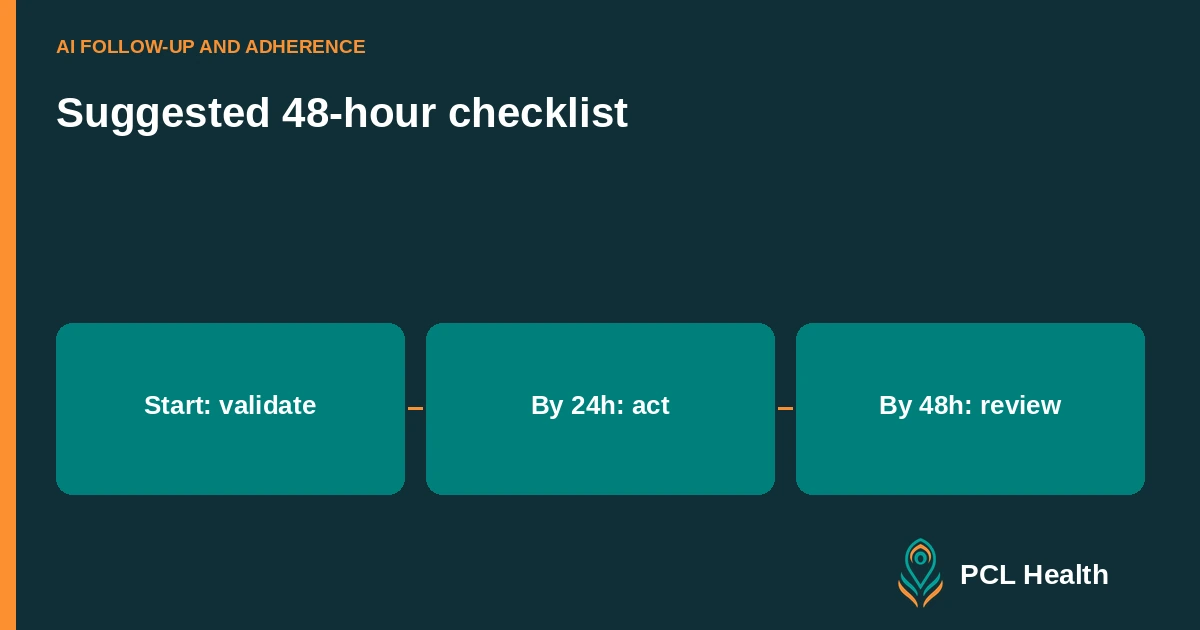
Validate the missing data, choose the appropriate contact and record the result. For a routine missed measurement, use the follow-up method your practice has agreed with the patient. For a technical problem or clinical question, assign the relevant staff member. Leave each unresolved item open with an owner and a next review point.
This is a suggested 48-hour operating checklist for routine missing data. Your clinical lead should define separate priority and response arrangements for concerns needing clinical attention. Staff should follow those arrangements whenever the contact reveals a different issue.
PCL Health supports missed-reading AI calls and records a summary in the patient's care plan. The AI voice calls workflow can support the reminder step; staff still need to review the outcome and confirm whether the requested reading arrives.
Record unsuccessful contact plainly. Do not change an unanswered call into “patient reminded.” Set the next attempt or handoff according to your practice's contact process, and make sure the next person can see what has already happened.
What should happen between 24 and 48 hours?
Check whether the action resolved the missing data. If a reading has arrived, confirm the relevant record is updated. If the issue remains open, review the earlier contact and change the next step to match the barrier. Escalate unresolved technical or clinical questions to the assigned team rather than repeating the same reminder indefinitely.
For a pairing issue, ask technical support to demonstrate successful receipt after troubleshooting. For unclear instructions, ask the clinical team to clarify the plan. If the patient remains unreachable, use your agreed contact procedure and document what remains unknown.
At the next queue review, the coordinator should see the last action, current status and next owner. Keep the outcome specific: “reading received,” “support arranged” or “contact still open.” A completed call is only one part of that account.
How does missing data affect the 16-day rule?
Match the data-day review to the applicable code and reporting period. In the 2026 RPM code structure, 99454 covers 16–30 days, while 99445 covers 2–15 days in a 30-day period. Your billing staff must assess the whole record and current payer rules; missed readings alone do not determine the claim decision.
See the CY 2026 final rule (2025) and CMS final-rule record (2025). Avoid applying “16 days” as a universal rule to every monitoring service or treating a device-day count as evidence that all other requirements are met.
PCL Health does not yet map 99445 or 99470. Your billing reviewer should distinguish the platform's four mapped codes from the broader coding options and payer requirements. Keep the underlying readings and staff activity available for review.
How can you prevent the same barrier from recurring?
Review recurring reasons for missed data with your team and improve the step that caused them. Recheck setup instructions, transmission testing and support ownership. Ask patients what made the process difficult. Use a small issue log to track whether the next action resolved the barrier, rather than labeling every repeat gap as nonadherence.
HHS recommends planning patient education, technical support and follow-up in its RPM strategy guidance (2026). Your own issue log can show where that planning needs adjustment.
Read the AI follow-up calls guide for the wider handoff, the device comparison for transmission planning and the interactive communication article for the distinction between automated contact and a qualifying staff conversation.
Main guide: AI follow-up calls in RPM
FAQ
Does a missing reading mean the patient forgot?
A missing record does not identify the cause. Check the expected schedule and transmission route before choosing the next contact.
What if the patient took a reading but it is not visible?
Ask staff to investigate the device, account and transmission path. Confirm receipt in the clinical workspace after the support action.
Does every RPM service require 16 days of readings?
The 2026 code structure distinguishes 99454 for 16–30 days and 99445 for 2–15 days in a 30-day period. Your billing staff should review the applicable service and other requirements rather than treating 16 days as a universal threshold. Source.
Can an automated reminder close the follow-up?
A completed reminder records the contact. Staff still need to check whether the reading arrived and whether an unresolved barrier needs further action.
Sources
This article is general information, not billing or legal advice. Confirm current payer requirements before submitting claims.