
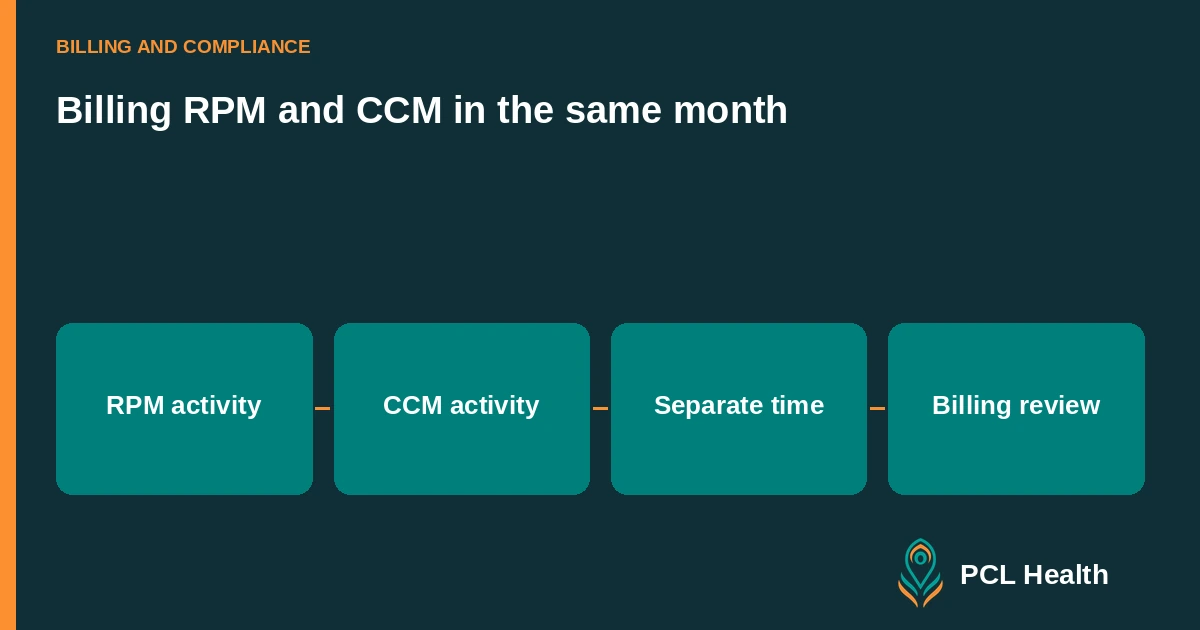
Medicare allows RPM and CCM to be billed in the same month when each service meets its requirements and the same time and effort are not counted twice. Keep the underlying activities separate enough that your billing team can explain what supports each claim. CMS remote-monitoring guidance (December 2025).
The practical challenge is the shared working day: one nurse, one patient and several related tasks. Use the following approach to make that work reviewable. The RPM billing requirements guide provides the wider code context.
Does enrollment in RPM also establish CCM eligibility?
Review eligibility for each service separately. A patient enrolled in RPM may also receive CCM, but a device assignment does not answer the CCM eligibility questions. Your clinician and billing staff need to identify the qualifying conditions, the services being provided and the documentation supporting both programs before reviewing the claim.
CMS describes CCM eligibility around two or more chronic conditions expected to last at least 12 months or until death, with significant risk of death, acute exacerbation, decompensation or functional decline. CMS CCM overview (2026).
Make your intake checklist ask two separate questions: why is monitoring needed, and why is ongoing chronic care management needed? Record the practitioner's answers where both teams can retrieve them. This also gives the coordinator a clearer explanation for the patient than “you qualify for both.”
How are RPM and CCM activities different?
Describe the purpose of the activity before assigning it to a service. RPM work relates to the monitored physiologic data and its management. CCM addresses the patient's broader chronic-care needs. Where a task touches both, write down what actually happened and ask your billing reviewer to resolve the allocation rather than copying the entry.
CMS's RPM overview describes device data used to manage a patient's condition; its CCM materials describe comprehensive care planning and coordination. CMS RPM overview (2026); CMS CCM booklet (June 2025).
| Illustrative activity | What to record | Question for billing review |
|---|---|---|
| Reviewing transmitted blood pressure data | Person, task, duration and resulting action | Which monitoring service does the work support? |
| Coordinating a chronic-care follow-up | Purpose, contacts, duration and next step | Does the work fit the patient's CCM service? |
| A conversation covering several needs | Distinct tasks and how the recorded time was allocated | Has any time or effort been counted twice? |
| An automated reminder | Trigger and outcome, separate from staff activity | Where is the qualifying staff work documented? |
Can you split one conversation between the two services?
Make the conversation's tasks and time allocation understandable before deciding what supports either service. One encounter can cover several subjects, but that does not create two copies of the elapsed time. If the note cannot support a defensible allocation, return it to the person who performed the work for clarification.
CMS says time counted toward CCM cannot be counted toward another billed code. CMS CCM booklet (June 2025). Your reviewer should examine the work, not divide the call mechanically to reach two thresholds.
For example, a nurse's conversation might move from transmitted readings to arranging a separate chronic-care follow-up. The useful note identifies those tasks and the time actually attributable to them. A single “RPM/CCM call” label leaves the next reviewer guessing.
What should the time record contain?
Record the patient, staff member, date, activity and duration, with enough context to explain the service allocation. Keep the original entry available when your reviewer opens a summary. If you correct an allocation, make the reason clear so the next person can follow the decision without restarting the whole review.
Start with a simple shared convention for activity descriptions. “Reviewed readings and discussed follow-up” tells the reviewer more than “care management.” A standard description can prompt detail, but it should not replace the description of the work actually performed.
At the end of the day, ask the coordinator to resolve ambiguous entries while the work is still fresh. Waiting until the month closes turns a short question into a reconstruction exercise.
PCL Health tracks care-management time and provides summaries without assigning CCM codes. See the CCM billing overview for how the records support your review.
Do the two services have the same time thresholds?
Review the threshold for the selected code and the person who performed the work. RPM and CCM have separate code families, and CCM includes different staff and practitioner categories. A combined monthly total cannot tell your reviewer whether the individual services meet their respective requirements or whether the time has been allocated correctly.
For reference, 99490 describes the first 20 minutes of qualifying clinical-staff CCM time per calendar month. CMS CCM booklet (June 2025). CMS explains 99457 and 99458 through care-management time and required real-time, two-way communication. CMS CY 2021 explanation.
Keep automated AI calls distinct from qualifying interactive communication. Use the interactive communication guide when checking the conversation record.
What changes should you track for the 2027 proposal?
Track the proposed RPM staffing and initiating-visit changes separately from the current rules for concurrent services. Identify who performs your monitoring work and how enrollment begins. Keep those proposed changes in a planning log, while your billing review uses the requirements applicable to the dates of the services being claimed.
CMS proposes that RPM be performed by clinical staff employed by the practice and begin with a separately reportable initiating visit. CMS also seeks comment on consolidating the RPM and RTM codes. These are proposed changes for CY 2027. CMS fact sheet (2026); Federal Register proposed rule (2026).
What should happen before you release the claims?
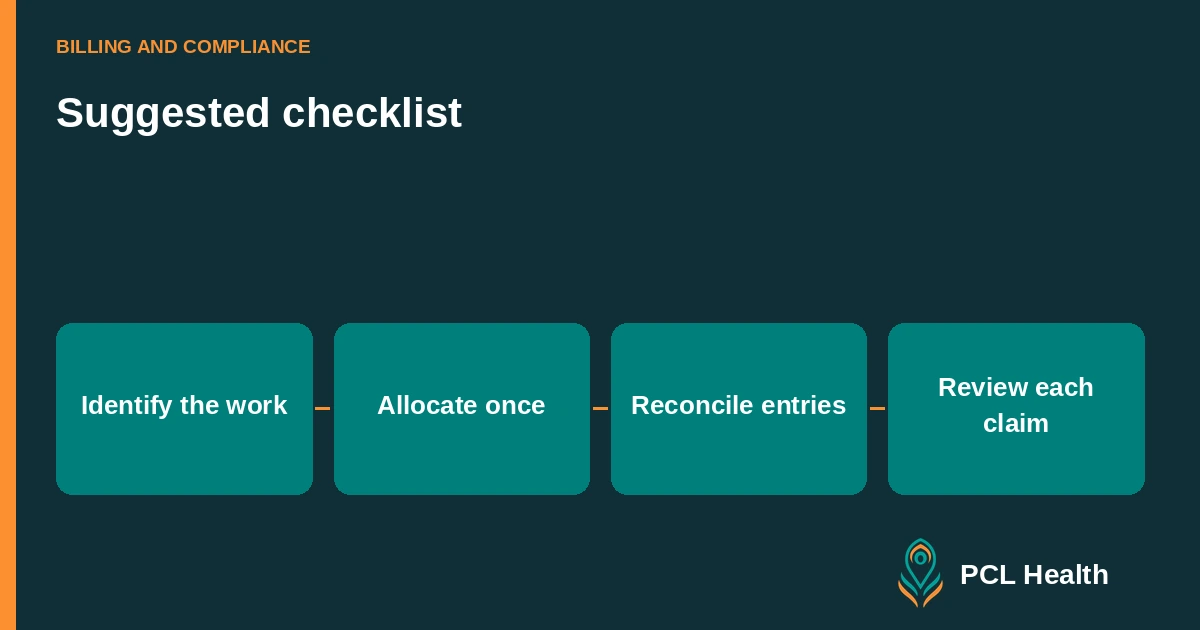
Have a named reviewer reconcile the two service records against the underlying entries. Resolve duplicated time, unclear task descriptions and missing supporting documentation before releasing the affected item. Keep an exception list with an owner and a next action so unresolved questions stay visible rather than disappearing into a monthly total.
- Confirm the services and eligibility separately.
- Compare the activity entries and service periods.
- Resolve duplicate allocations and unclear descriptions.
- Check each selected code's remaining requirements.
- Record the review decision and any outstanding question.
The RPM audit checklist helps you assemble the supporting packet. Documentation supports billing review; it does not establish eligibility or guarantee reimbursement.
Main guide: RPM billing requirements
FAQ
Can RPM and CCM be billed in the same month?
CMS permits concurrent RPM and CCM when each service meets its requirements. The same time and effort cannot be counted toward both services. Source.
Does RPM enrollment establish CCM eligibility?
Review eligibility separately for CCM. CMS describes CCM for patients with multiple chronic conditions and the associated risk requirements. Source.
Can the same time count for 99457 and 99490?
The same time cannot be counted twice. Your billing staff should review the actual activity, the allocation and all requirements for each selected code. Source.
Does the platform assign CCM codes?
PCL Health tracks care-management time and provides summaries. PCL Health does not assign CCM codes; your billing staff review the applicable requirements.
Sources
- CMS: Telehealth and remote monitoring (December 2025)
- CMS: Chronic care management overview (2026)
- CMS: Chronic care management services (June 2025)
- CMS: Remote patient monitoring (2026)
- CMS: CY 2021 final-rule explanation
- CMS: CY 2027 proposed-rule fact sheet (2026)
- Federal Register: CY 2027 proposed rule (2026)
This article is general information, not billing or legal advice. Confirm current payer requirements before submitting claims.